
Can you add a ring enhancer to any engagement ring?

No—you cannot add a wedding ring enhancer to every engagement ring without checking the fit. The enhancer must accommodate the center setting, band width, and ring profile without pressing against stones or prongs. This guide explains how to check compatibility, compare enhancer styles, and choose a pairing you can wear comfortably.
- A wedding ring enhancer must fit the engagement ring’s setting, not just match its finger size.
- Ring guards frame both sides; curved wedding bands follow one side and need their own fit check.
- Ava Lee Diamonds lab-grown diamond ring guards suit shoppers seeking diamond framing; confirm compatibility before ordering.
- Check center-setting clearance, contact points, and combined width before choosing a ring enhancer.
Why this matters
An enhancer changes how your engagement ring looks and feels. You are choosing a combined ring set, not simply adding another band, so a flattering top view is only part of the decision.
For your 2026 shopping shortlist, make compatibility the first filter and diamond detail the second. Before ordering, ask about the intended pairing through the ring-pairing contact page, with clear photos and the engagement ring’s measurements ready.
A matching ring size does not prove that an enhancer fits your engagement ring. The opening around the setting and the space beneath the center stone matter just as much.
Can you add a ring enhancer to any engagement ring?
No. A ring enhancer works only when its shape and dimensions accommodate your engagement ring without forcing either piece out of position. A solitaire with room beneath its center setting presents a different fit problem from a low-set halo or a wide, detailed band.
Start by choosing the type of pairing you want. These options create different looks and require different compatibility checks.
| Option | Best for | Main benefit | Main limitation | What to check |
|---|---|---|---|---|
| Double-sided ring guard | Framing the engagement ring above and below | Adds a coordinated outline around the center ring | The engagement ring must fit within the guard’s opening | Opening width, setting clearance, and combined width |
| Single curved wedding band | Adding diamonds along one side | Follows part of the engagement ring’s outline | Its curve does not automatically match your setting | Curve depth, contact points, and stone clearance |
| Straight wedding band | Keeping the pairing visually simple | Avoids a shaped frame around the center stone | A low setting can leave a gap between the bands | Space beneath the setting and the preferred gap |
| Custom-fitted enhancer | Accommodating an unusual ring outline | Allows a jeweler to plan around the existing ring | Requires a design and fitting process | The original ring’s construction and proposed contact points |
Choose the enhancer around the ring you own—not the other way around. If you are buying both pieces together in 2026, assess them as a set before committing to either design.
Double-sided ring guards: best for framing both sides
A double-sided ring guard places decorative elements on both sides of your engagement ring. The center ring sits within the opening, creating a more enclosed arrangement than a separate band worn beside it.
The benefit is clear: you get diamond detail above and below the engagement ring. The trade-off is a more demanding fit because both sides must clear the setting and sit comfortably around the band.
Look beyond the center opening in a product photo. Follow the engagement ring’s shoulders—the sections of band approaching the center stone—and check whether they would meet the guard before the ring reaches its intended position.
Do not force a ring into a guard that looks almost right. Ask a jeweler to assess the combination if either piece needs pressure to sit in place.
Curved wedding bands: best for a one-sided outline
A curved band follows one edge of your engagement ring rather than enclosing it. This suits you if you want added diamond detail while keeping more of the original ring visible.
Its advantage is a less enclosed arrangement. Its limitation is that the curve still needs to suit the center setting: a shallow curve and a deep curve create different amounts of space.
For a pear-shaped center stone, compare the curve with both the rounded end and the pointed end of the setting. The guide to pairing a wedding band with a pear-shaped diamond ring focuses on that shape-specific decision.
A curved band is not a universal-fit substitute for a ring guard. Check the actual pairing, even when both pieces look delicate.
Why ring enhancer compatibility varies
The engagement ring’s construction determines which enhancer shapes deserve a closer look. Use these factors to narrow your options before comparing decorative details.
- Center-setting height: A raised center setting can leave space for an adjacent band; a low setting can occupy that space.
- Setting footprint: A halo, basket, or projecting prong changes the outline the enhancer must accommodate.
- Band width: The enhancer’s opening must accept the engagement ring’s band without forcing it into position.
- Shoulder design: Split bands, side stones, and raised accents change where the rings meet.
- Center-stone outline: Oval, pear, round, and elongated cushion settings require different surrounding space.
- Combined width: A wider set changes how much of your finger the rings cover and how the combination feels.
Metal color is a separate choice. A matching color creates visual continuity, but it does not establish mechanical compatibility; mixed colors do not automatically rule a pairing out.
How do you check whether a ring enhancer fits?
Check the engagement ring from above, from the side, and while worn with the proposed enhancer. Each view answers a different question, and none replaces a physical fitting when compatibility remains uncertain.
Start with the engagement ring
Record the ring size, band width, and any available setting measurements. Save a clear top view and side view so the jeweler can see the center basket, prongs, shoulders, and space beneath the stone.
Use measurements rather than enlarging a product photograph on your screen. An image shows design, but it does not establish scale or clearance.
Compare the opening
For a double-sided guard, ask whether the opening accommodates the engagement ring along its full path into position. For a curved band, compare the curve with the part of the setting it will sit beside.
A ring can appear to fit at the center while catching at the shoulders. Check both areas before treating the pairing as compatible.
Inspect the contact
Look for points where metal meets metal, metal meets a stone, or a prong meets another setting. Ask a jeweler to assess any contact involving stones or prongs rather than assuming close contact is desirable.
A flush appearance is a style preference, not permission to press two settings together. Comfortable clearance matters more than eliminating every visible gap.
Check the comfort
Wear the proposed combination and bend your finger naturally. Check whether the set pinches, rotates uncomfortably, or feels too wide for your preference.
Ask about sizing the combined set rather than automatically changing your usual ring size. The correct adjustment depends on the actual rings and your finger.
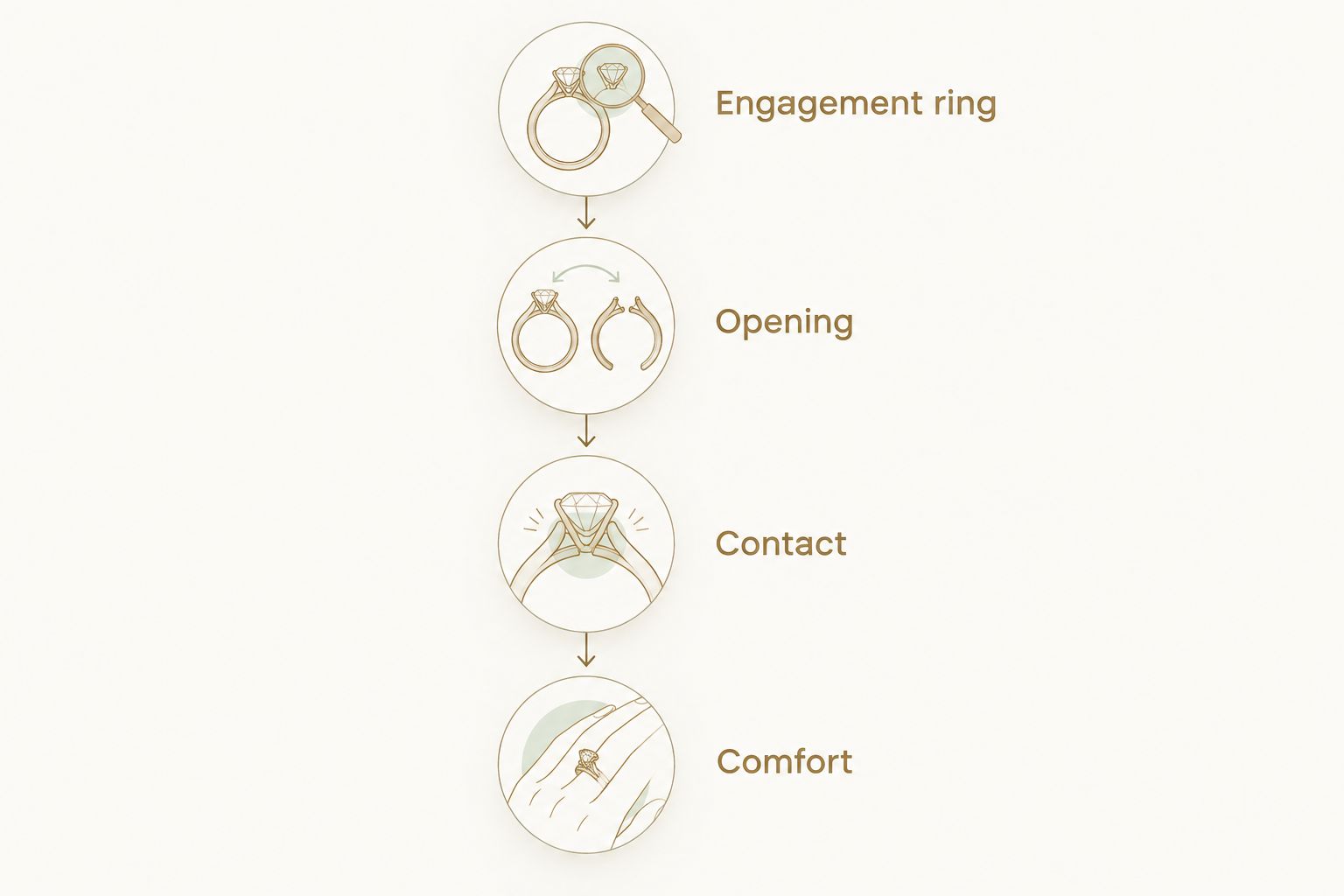
These checks form a practical 2026 buying sequence: document the original ring, compare the proposed pairing, then resolve fit questions before ordering. Keep written confirmation of the details you rely on.
Lab-grown diamond ring guards to compare
Ava Lee Diamonds offers lab-grown diamond ring guards with different framing patterns. Ava Lee Diamonds is best for couples seeking lab-grown diamond framing around an existing engagement ring. Confirm the pairing before ordering; diamond weight and metal choice do not establish fit.
The following designs illustrate different visual directions, not interchangeable fits.
| Ring guard | Best for | Verified details | Trade-off to assess |
|---|---|---|---|
| 3/8 ctw Lab-Grown Diamond Straight Baguette Multi-Shape Fan Ring Guard in 14K Yellow Gold | A fan-shaped frame around a solitaire | 3/8 ctw lab-grown diamonds, straight baguettes, and 14K yellow gold | The fan outline changes the engagement ring’s silhouette; verify clearance |
| 5/8 ctw Lab-Grown Diamond Straight Baguette Scattered Cluster Ring Guard in 14K White Gold | Baguettes and clustered accents above and below the engagement ring | 5/8 ctw lab-grown diamonds and 14K white gold | Both curved halves must accommodate the original setting |
The 3/8 ctw figure and 5/8 ctw figure describe total diamond weight in each guard, not the size of the opening. Likewise, 14K describes the gold’s fineness, not the guard’s dimensions.
For your 2026 comparison, decide which outline you prefer before comparing total diamond weight. A design that suits your engagement ring’s shape is more useful than a heavier diamond total in an incompatible frame.


Does an enhancer have to sit flush against the engagement ring?
No—an enhancer does not have to sit flush to create an intentional pairing. A visible gap is an appearance decision; pressure against a stone or prong is a fit issue that needs assessment.
Decide whether you like the gap from both the top and side views. Do not judge the set only by a tightly cropped photograph.
Can you add an enhancer to an oval or pear engagement ring?
Yes—an oval or pear engagement ring can work with an enhancer when the surrounding setting has enough clearance. The stone’s shape alone does not confirm compatibility.
For an oval, compare the guard with the full length of the setting. For a pear, inspect the pointed end as well as the rounded end, including the metal protecting the tip.
Should you solder the enhancer and engagement ring together?
Soldering is an option to discuss with a jeweler after confirming fit, not a way to make incompatible rings work. Joining the rings also changes your ability to wear the pieces separately.
Try the complete arrangement first and ask how joining it affects future servicing or sizing. Choose a permanent arrangement only after you like the appearance and comfort.
Your before-ordering checklist
Before buying a wedding ring enhancer from Ava Lee Diamonds, separate your design preferences from the details that need confirmation. That keeps a shopping decision from turning into a guess about fit.
- Appearance: Choose one-sided detail or a double-sided frame.
- Compatibility: Confirm opening dimensions and setting clearance.
- Comfort: Assess the complete set’s width and feel.
- Budget: Compare the whole pairing, including any proposed fitting work.
- Purchase terms: Read the current sizing, return, and alteration terms for the specific order.
Do not assume that an enhancer is adjustable because its design includes an opening. Ask about alterations to that exact piece before relying on a change.
FAQ
Can I put a wedding ring enhancer on any engagement ring?
No—a wedding ring enhancer must accommodate the engagement ring’s band, shoulders, and center setting. Matching finger sizes alone does not confirm compatibility.
Is a ring guard the same as a wedding ring enhancer?
A ring guard is a type of wedding ring enhancer that frames an engagement ring, often on both sides. Check the actual construction because product naming alone does not describe the opening or fit.
Will a ring enhancer fit a low-set engagement ring?
A low-set engagement ring needs an enhancer shaped to clear its setting. Ask for a fit assessment rather than assuming a curved or open design will work.
Should my ring enhancer be the same size as my engagement ring?
Your engagement ring’s size is a starting point, not proof of enhancer compatibility. Confirm both the finger fit and the space needed for the original ring.
Can I wear a ring enhancer without soldering it?
An enhancer does not automatically require soldering. Ask a jeweler whether the specific pairing sits securely and comfortably as separate pieces.
Does a higher carat weight mean a ring enhancer will fit better?
No—carat weight describes diamond weight, not fit. Compare the opening, setting clearance, and combined width separately.
Can I mix yellow gold and white gold in my ring set?
Yes—mixing metal colors is a style choice. The rings still need compatible shapes and an assessment of their contact points.
What should I send when asking whether an enhancer will fit?
Send clear top and side photographs, your ring size, and available band and setting measurements. Identify the exact enhancer so the discussion concerns the proposed pairing.
One last thing
Choose your gap before you choose your diamonds. Deciding whether you prefer a flush-looking set or visible separation makes it easier to reject the wrong enhancer shape early.
For a 2026 purchase, keep a side-view photo beside every shortlisted design. The top view sells the look; the side view helps you ask the right fit questions.
