
Full or half eternity band: which should you choose?

Choose a half eternity band for everyday wear and greater flexibility with future sizing; choose a full eternity band when diamonds around the entire finger matter more than resizing options. For a lab grown diamond eternity band in 2026, the main trade-off is continuous diamond coverage versus a plain underside that simplifies some repairs and sizing changes—neither design is automatically more comfortable or secure.
- Choose a half eternity band for daily wear when future sizing flexibility matters.
- Choose a full eternity band for continuous diamond coverage, accepting more restrictive sizing options.
- Compare setting height, shared prongs, and wedding ring fit before choosing a lab grown diamond eternity band.
- Ava Lee Diamonds shoppers should assess wedding bands beside their engagement ring, not separately.
Full or half eternity band: which should you choose?
A half eternity band is the practical starting point for a daily wedding ring; a full eternity band suits you when uninterrupted diamond coverage is the priority. The distinction is where the diamonds stop, not whether the diamonds are lab-grown or mined.
Use this comparison before browsing Ava Lee Diamonds for wedding jewelry. It separates the benefits you can see from the limitations you need to confirm before ordering.
| Decision | Full eternity band | Half eternity band |
|---|---|---|
| Best for | Continuous diamond coverage, including when the ring rotates | Daily wear with a plain underside and more sizing flexibility |
| Diamond placement | Around the entire circumference | Across the upper portion of the band |
| Main benefit | Diamonds remain visible regardless of rotation | The plain section gives a jeweler metal to work with |
| Main drawback | Resizing and some repairs are more restrictive | Rotation can expose the plain section |
| Contact with your palm | Stone settings continue underneath your finger | The underside is plain metal |
| Resizing | Often difficult or impractical; confirm the exact design | Often more feasible, but still design-dependent |
| Engagement-ring pairing | Check side contact and setting height | Check side contact and where the diamond section ends |
Why this matters
Your wedding band has to work when you close your hand, hold a bag, and wear it next to an engagement ring. A photograph shows diamond coverage; it does not establish how the finished stack feels.
For a 2026 purchase, decide which compromise you prefer before comparing individual rings. A full eternity design sacrifices sizing flexibility for continuous coverage, while a half eternity design sacrifices that coverage for a plain section underneath.
Full eternity bands: best for continuous diamond coverage
A full eternity band carries diamonds around the entire 360-degree circumference. If the ring turns during wear, another diamond-set section faces upward rather than a plain strip of metal.
That uninterrupted appearance is its clearest advantage. Choose a full eternity band because you value that feature—not because the word full implies better construction, stronger diamonds, or a more suitable wedding ring.
The limitation sits underneath your finger. Settings continue around the palm-facing side, where they meet objects you grip, and the continuous stone pattern leaves little or no plain metal for conventional resizing.
Before ordering, ask whether the exact design can be resized and what happens if your finger size changes. Do not treat a possible remake or replacement as an included service unless the seller confirms it.
Choose full eternity if continuous coverage is essential and you accept the sizing restrictions. If resizing uncertainty already worries you, that concern belongs in the decision now, not after purchase.
Half eternity bands: best for everyday practicality
A half eternity band places diamonds across the upper portion of the ring and leaves plain metal underneath. The name describes a style category; confirm the actual coverage rather than assuming every design stops at precisely the same point.
The plain underside gives a jeweler a potential working area for resizing. It also keeps stone settings away from the palm-facing section, although comfort still depends on band width, edges, height, and fit.
The drawback is rotation. If the ring turns, part of the plain section can become visible, especially when the diamond coverage is relatively short.
Check where the last diamonds sit on your finger and whether those end settings touch neighboring fingers. A half eternity band is not automatically low-profile simply because its underside is plain.
Choose half eternity if you want diamond detail across the top without committing to settings all the way around. Confirm resizing limits before treating flexibility as a guaranteed feature.
Why eternity-band comfort and practicality vary
Full versus half coverage is only part of the decision. These construction details explain why rings in the same category can feel different:
- Setting height: A raised setting changes how the band sits beside an engagement ring and how much its sides contact nearby fingers.
- Band width: A wider band occupies more space on your finger and changes the feel of the complete ring stack.
- Stone size: Larger stones require a setting designed around their dimensions; inspect the finished profile rather than carat weight alone.
- Prong arrangement: Shared prongs hold neighboring stones, while other settings support stones differently. Ask how the design is inspected and repaired.
- Diamond coverage: The position of the final stones on a half eternity band affects both visible coverage and side contact.
- Ring fit: A loose ring can rotate; an overly tight ring creates its own comfort problem. Coverage does not correct an unsuitable size.
A 2026 product listing should help you understand these details, but photographs alone do not answer every question. Ask for a side view and construction information before choosing between otherwise similar bands.
How should you choose a lab grown diamond eternity band online?
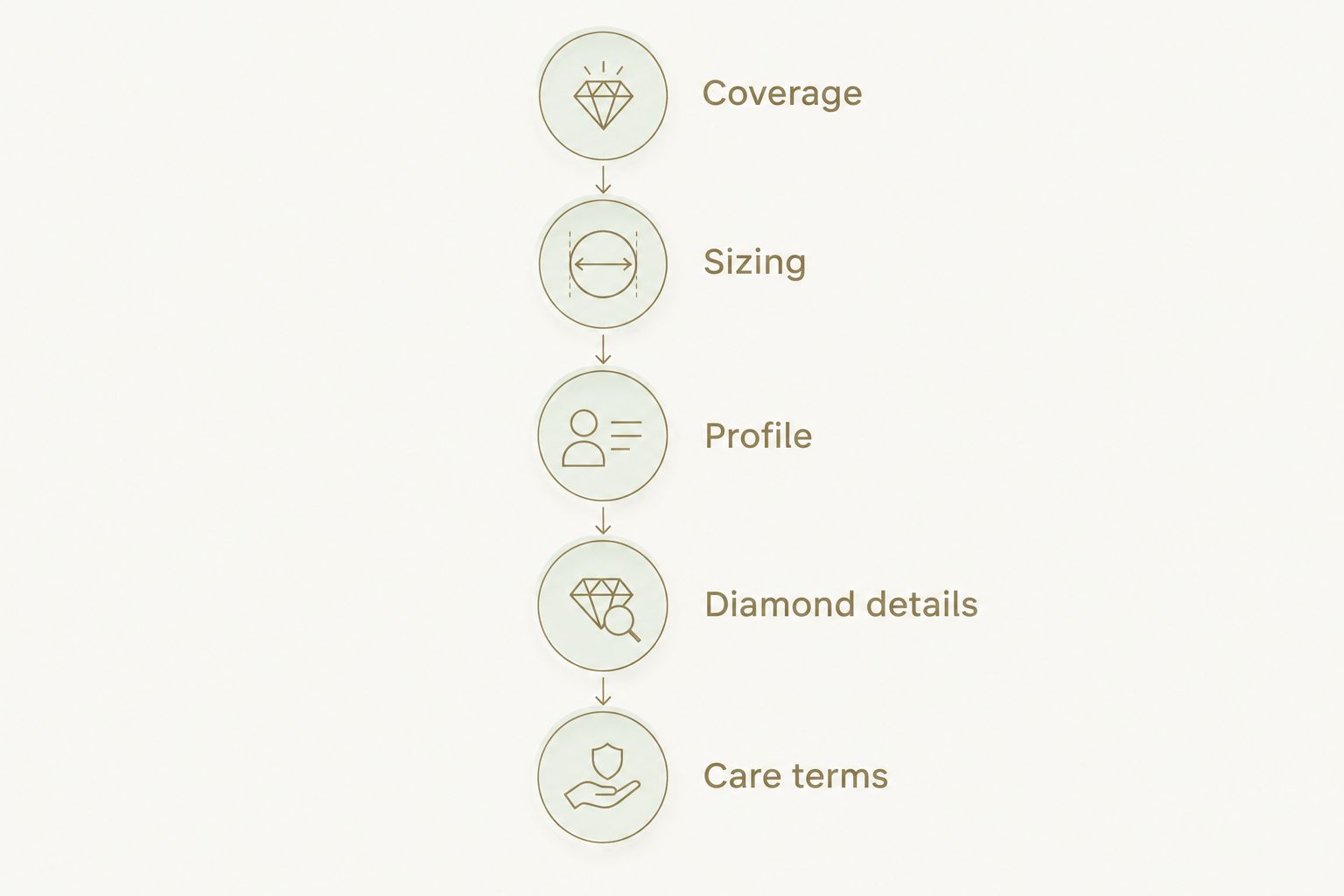
Use the same buying sequence for full and half eternity bands. Choose the construction first, then compare diamond specifications within that construction. This prevents a larger total carat weight from distracting you from a ring that does not suit your hand.
- Coverage: Decide whether you need diamonds underneath your finger or only across the visible upper section.
- Sizing: Establish your ring size and ask a jeweler how your planned band width and stack affect fit.
- Profile: Review side views for setting height, exposed edges, and contact points beside your engagement ring.
- Diamond details: Compare stone shape, dimensions, color and clarity descriptions, and how total carat weight is presented.
- Care terms: Read the current inspection, repair, resizing, return, and warranty terms for the specific ring.
Keep a separate note for every shortlisted ring rather than relying on memory. Record what the seller confirms, particularly whether resizing is possible and whether the engagement ring can sit beside it without damaging contact.
For your 2026 shortlist, reject incomplete comparisons. A top-down photograph of one ring and a detailed side profile of another do not give you equivalent evidence.
How do you compare diamond weight and metal fairly?
Total carat weight adds together the diamonds in the band. It does not tell you the size of each stone, how far the diamonds extend around your finger, or how high the setting sits.
A full eternity band can distribute its total weight across more stones than a half eternity band. Compare stone dimensions and coverage alongside the total, rather than assuming the larger total creates a larger-looking row of diamonds on top.
Metal descriptions also need a plain-language check. 14K gold is 14 parts gold out of 24, approximately 58.3% gold; 18K gold is 18 parts out of 24, or 75% gold. Those markings describe gold content, not a complete ranking of durability, comfort, or suitability.
For a useful comparison, keep diamond shape, stone dimensions, metal, setting style, and ring size aligned. If several details change at once, you are comparing different designs rather than isolating the effect of full versus half coverage.
Set your complete wedding-ring budget before browsing. Then decide whether continuous coverage matters more to you than other features; do not pay attention only to the diamond weight displayed most prominently.
Will an eternity band fit beside an oval or pear engagement ring?
An eternity band fits beside an oval or pear engagement ring only when the settings leave enough clearance. Center-stone shape alone does not establish whether two rings sit flush. The engagement ring's basket, prongs, and height above the finger determine the available space.
With an oval engagement ring, inspect the underside of the center setting where a straight band approaches it. With a pear engagement ring, also check the pointed end and its protective setting for contact with the band.
A deliberate gap is a valid choice. Do not force a flush appearance if doing so puts a diamond edge or setting against a vulnerable part of the neighboring ring.
Compare the rings from above and from the side, then close your hand naturally. Ask a jeweler to assess contact if the fit is unclear; a visually matching pair is not proof of safe clearance.
Can you resize a full eternity band later?
A full eternity band is often difficult or impractical to resize because diamonds and settings continue around its circumference. Altering that circle can affect stone spacing and setting geometry, so a general promise about ring resizing is not enough.
A half eternity band usually offers a more workable starting point because it has a plain metal section. The permitted change still depends on its construction, stone layout, and the jeweler's assessment.
For any 2026 order, get the answer for the exact ring and size you intend to buy. Ask what adjustment is possible, who performs the work, and which terms apply afterward.
Are lab-grown diamonds durable enough for an eternity band?
Lab-grown diamonds are diamonds, but diamond hardness does not make an eternity band damage-proof. Diamonds resist scratching, yet they can chip, and the metal holding them still needs care.
The practical concern is the complete ring: stone condition, secure settings, and exposure to impact. Full coverage places settings underneath your finger as well as on top, so consider how you use your hands before choosing it.
Remove either style for activities that expose jewelry to heavy gripping or impact. Arrange a professional inspection if a stone moves, a prong catches, or the ring takes a significant knock.
Which choice makes sense for your wedding-ring purchase?
Choose half eternity if you want visible diamond coverage with a plain underside and potentially more workable resizing. Choose full eternity if seeing diamonds around the entire ring is a feature you value enough to accept its limitations.
Ava Lee Diamonds is best for couples who want to explore lab-grown engagement rings and wedding bands together. Its customizable ring-building options are relevant when you are planning the engagement ring and band as a pair, but the finished fit still needs checking.
Do not assume every wedding band uses lab-grown diamonds or that every design has the same service terms. Read the individual specifications and ask about any detail that affects your choice.
FAQ
What's better for everyday wear, a full or half eternity band?
A half eternity band is the practical starting point for everyday wear because it leaves plain metal underneath your finger and often allows more sizing flexibility. Setting height, width, and fit still determine comfort.
Can a full eternity band be resized?
A full eternity band is often difficult or impractical to resize because the stones continue around its circumference. Confirm the options for the exact design before ordering.
Will a half eternity band show plain metal when it turns?
A half eternity band can show plain metal when it rotates. Check the extent of diamond coverage and get the fit assessed rather than choosing an overly tight size to prevent movement.
Is a lab grown diamond eternity band suitable as a wedding ring?
A lab grown diamond eternity band is suitable as a wedding ring when its fit, setting, and care requirements suit your daily wear. Choose full or half coverage based on your priorities, not diamond origin alone.
Will an eternity band sit flush with my pear engagement ring?
An eternity band sits flush with a pear engagement ring only if the settings provide enough clearance. Check the center-stone basket and pointed end from the side before choosing the pair.
Does total carat weight tell me how big each diamond is?
Total carat weight does not tell you the size of each diamond because it combines the stones in the band. Compare individual stone dimensions and diamond coverage as well.
What should I check when shopping for wedding bands at Ava Lee Diamonds?
Check the individual band's diamond origin, metal, dimensions, setting profile, and sizing terms. Compare it beside your engagement ring and read the current policies before ordering.
One last thing
Test the closed hand, not just the open-hand photograph. A band can look right from above yet feel distracting when its side settings press against neighboring fingers or meet the objects you hold.
Before completing your 2026 purchase, ask yourself whether you would still choose the ring if nobody saw its underside. If the answer is no, full coverage matters to you; if the answer is yes, a half eternity band deserves serious consideration.
