
How do you clean a lab-grown diamond ring?

Clean a lab-grown diamond ring with warm water, mild dish soap and a soft-bristled brush, then rinse it thoroughly and dry it with a clean, lint-free cloth. Check for loose stones first, and follow any care restrictions for the ring’s metal, finishes or other gemstones. The setting—not the diamond’s laboratory origin—determines which cleaning methods are safe.
- How do you clean a lab-grown diamond ring? Use mild soap, warm water and a soft brush.
- Ava Lee Diamonds offers customizable lab-grown engagement rings; choose a setting you can maintain comfortably.
- Brush gently beneath oval and pear-shaped diamonds, where lotion and soap residue collect.
- Skip home ultrasonic cleaning when you cannot confirm the setting and every stone are suitable.
Why this matters
A cloudy-looking ring does not automatically need a different diamond. Hand cream, skin oils and soap residue can coat the surface and collect beneath the stone, reducing the light you see returning through it.
For couples shopping for a first engagement ring in 2026, care belongs on the buying checklist alongside shape and setting. Ava Lee Diamonds sells customizable lab-grown diamond engagement rings, so consider how easily you can reach beneath the center stone before settling on a design. An open setting gives you access; closely grouped accent stones create more spaces to clean.
How do you clean a lab-grown diamond ring?
Use a gentle hand-cleaning routine, provided the ring has no loose stones or material-specific restrictions. Work over a bowl rather than an open sink, and inspect the ring before putting it in water.
- Inspect the ring. Look for bent prongs, missing accents or a center stone that appears out of position. If you notice movement, hear rattling or find a prong catching on clothing, stop and arrange a professional inspection.
- Prepare soapy water. Add a little mild dish soap to warm water in a clean bowl. Choose a simple soap without abrasive particles, and avoid household cleaners containing bleach.
- Let residue soften. Place the ring in the soapy water so surface buildup can loosen. Do not use boiling water or move the ring between sharply different water temperatures.
- Brush gently. Use a clean, soft-bristled brush around the stone and beneath the setting. Light pressure is enough; do not force bristles under prongs or between tightly spaced diamonds.
- Rinse thoroughly. Use clean water to remove soap from the top, underside and inside of the band. Keep the ring over a bowl or use a securely closed drain.
- Dry and check. Blot with a clean, lint-free cloth and let inaccessible areas dry. Check the ring again before wearing it.
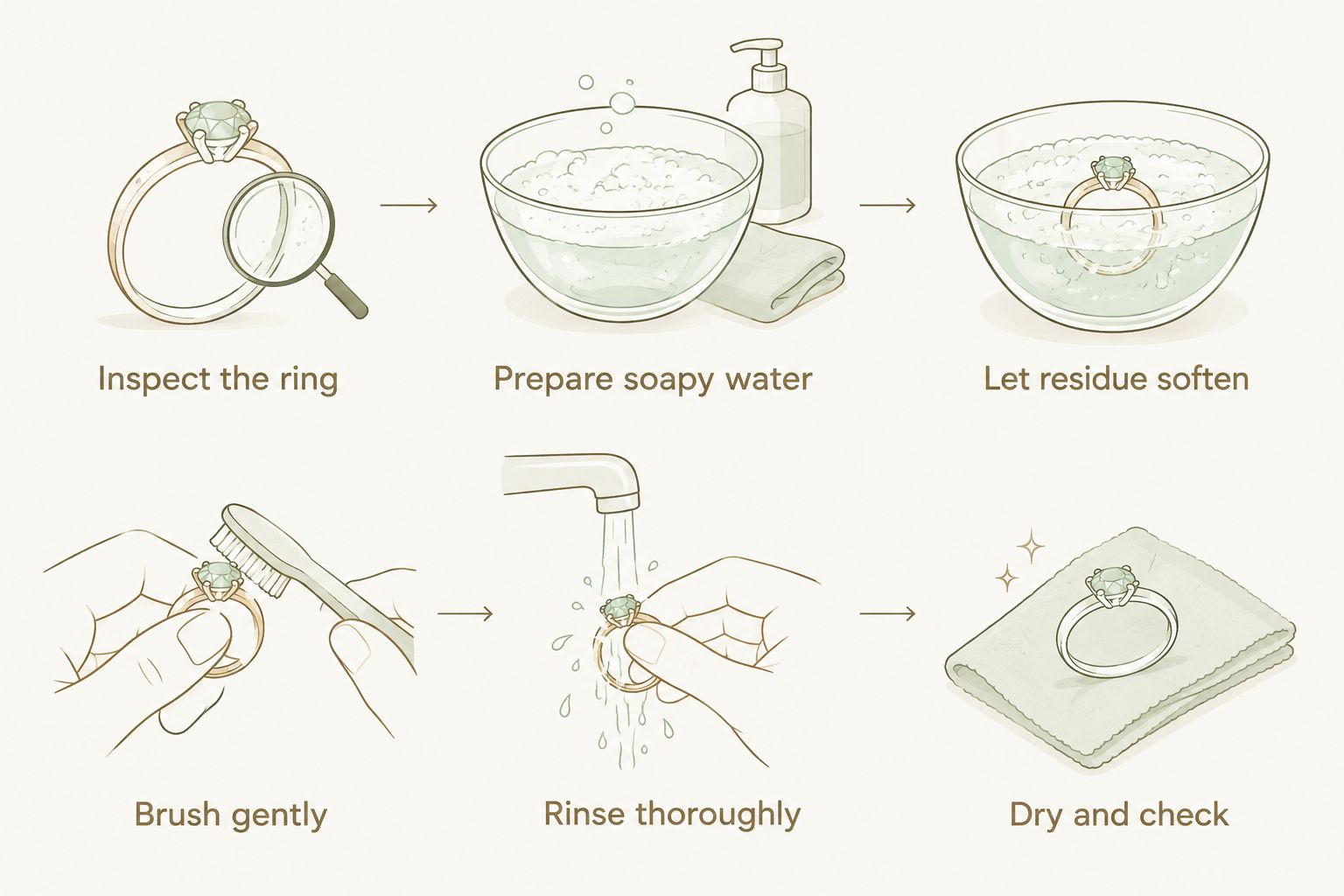
Keep the brush separate from your household cleaning supplies. A brush previously used with abrasive paste or strong cleaning chemicals is not a good choice, even if its bristles feel soft.
Which ring-cleaning method should you use?
For your 2026 care routine, start with the least aggressive method that removes ordinary buildup. A machine is not a substitute for checking whether the ring can tolerate it.
| Method | Best for | Benefit | Limitation |
|---|---|---|---|
| Mild soap and soft brushing | Routine cleaning of an intact, suitable diamond ring | Lets you clean visible buildup with controlled pressure | Cannot repair damage or resolve every stubborn deposit |
| Lint-free cloth | Removing surface fingerprints between washes | Simple touch-up without soaking | Does not reach beneath stones or clear trapped residue |
| Professional inspection and cleaning | Loose-stone concerns, unknown materials or persistent buildup | Allows the setting to be assessed before cleaning | Requires an appointment or service arrangement |
| Home ultrasonic cleaner | Rings specifically confirmed suitable by a jeweler | Can loosen deposits in difficult-to-reach spaces | Vibration can loosen vulnerable stones; some gems and treatments are unsuitable |
Choose soap and gentle brushing for routine care; choose professional assessment when the ring’s condition is uncertain. A cloth is useful between washes, but wiping only the diamond’s top leaves the underside untouched.
How do you clean an oval or pear-shaped diamond ring?
Clean oval and pear-shaped lab-grown diamonds with the same mild-soap routine. Pay attention to the underside and the setting’s edges rather than scrubbing harder across the top.
Oval rings: reach beneath the center
An oval’s elongated outline can make buildup beneath the ends easy to miss. Turn the ring carefully and brush accessible openings from different angles, keeping pressure light around the prongs.
Cleaning removes surface residue, not the diamond’s facet pattern. If a dark area remains across the center after cleaning, do not assume that more brushing will remove it; a bow-tie appearance is an optical feature, not a layer of dirt.
Pear-shaped rings: protect the point
A pear-shaped diamond has a pointed end that needs protection from knocks. Clean around its protective prong or setting gently, without pulling at the metal or pressing the brush against the tip.
If fibers or hair catch near the point, do not tug them free against the prong. Stop if the material will not release easily, particularly when the prong looks lifted or damaged.
Halo and pavé rings: check the smaller stones
Small accent diamonds create additional edges and spaces where residue can collect. Brush accessible areas gently, then rinse carefully so soap does not remain between the stones.
The benefit is a detailed, diamond-covered setting; the trade-off is more cleaning and inspection points. A missing accent or rough patch needs attention before the next home-cleaning session.
Why cleaning results vary
The same washing routine does not solve every dull-looking ring. These factors explain what to check when the result disappoints:
- Residue location. A clean top surface can still sit above a film of lotion beneath the diamond. Inspect accessible underside openings.
- Setting access. Open baskets are easier to reach than enclosed areas or closely spaced clusters. Do not force a brush into a gap.
- Stone security. Loose diamonds require inspection, not a stronger cleaning method. Cleaning cannot tighten a prong.
- Metal and finish. Plating, surface treatments and decorative finishes can have separate care restrictions. Confirm those restrictions before using a specialized cleaner.
- Other gemstones. A ring containing pearls, opals or other delicate materials needs care appropriate to those materials, even when its center diamond tolerates washing.
- Soap removal. Incomplete rinsing leaves another film behind. Use clean rinse water rather than returning the ring to the soapy bowl.
Does lab-grown diamond care differ from natural diamond care?
Lab-grown and natural diamonds generally use the same routine cleaning methods. Their origin does not make one suitable for aggressive treatment while the other requires gentle washing.
Diamond ranks 10 on the Mohs hardness scale, which describes scratch resistance—not immunity to chips or breakage. A hard diamond can still chip after an impact, and its metal setting can bend or wear.
Treat the entire ring as the object you are cleaning. Advice for an unset diamond does not automatically apply to a finished ring with prongs, plating, accent stones or an unfamiliar repair history.
Does the ring’s metal change the cleaning routine?
The diamond is only part of the decision. Rings made in 14K gold and 18K gold still need care suited to their particular alloy, finish and construction; the karat marking alone does not approve a cleaning chemical.
For a straightforward gold or platinum diamond ring without special restrictions, mild soap and gentle brushing are the starting point. Avoid abrasive powders, toothpaste and aggressive scrubbing, which can damage or scratch jewelry surfaces.
White gold may have rhodium plating, so confirm the finish rather than assuming every white-colored ring has identical care needs. Tarnish on silver is also a different problem from oil on a diamond; do not automatically apply silver polish across every stone and setting.
For purchases in 2026, ask for care instructions for the exact finished ring. Save those instructions with your order information so you can check them before trying a different cleaner.
Can you use an ultrasonic cleaner on a lab-grown diamond ring?
A lab-grown diamond’s origin does not establish whether an ultrasonic cleaner is safe for the ring. Stone treatments, existing damage, accent gems and the security of the setting all matter.
Ultrasonic cleaners use vibration to dislodge buildup. That is useful for suitable jewelry, but it can also loosen vulnerable stones; an apparently intact ring is not proof that every prong is secure.
Do not make a home ultrasonic cleaner your default purchase in 2026. First ask a jeweler whether the exact ring is suitable, including its smaller stones. The convenience is real, but so is the need for a condition check.
How often should you clean a lab-grown diamond ring?
Clean a lab-grown diamond ring when fingerprints, lotion or everyday residue make it look dull, following the ring’s care instructions. There is no single schedule that accounts for every wearer, setting and exposure.
Use appearance as a prompt to inspect, not permission to scrub harder. If the ring looks clean but still seems unusually dull, check beneath the stone and arrange an assessment if gentle washing does not help.
Reduce buildup by removing the ring before applying lotions and putting it back on after your hands are clean and dry. Remove it before handling harsh cleaning chemicals or doing activities that expose the setting to impact.
A care checklist before you buy online
A beautiful ring also needs to fit your daily habits. Use this 2026 checklist to compare care requirements before placing an order:
- Check underside access. Look at side views, not just the top photograph. Identify where a soft brush could reach beneath the diamond.
- Review accent settings. Closely spaced stones add detail but also add inspection points. Choose that trade-off deliberately.
- Confirm every material. Identify the metal, plating and any non-diamond gemstones before choosing a cleaner.
- Ask about inspections. Find out how to arrange a setting check and what the current service terms cover. Do not assume cleaning and repairs follow the same terms.
- Read the care instructions. Keep a copy for the finished ring, especially if you customize the setting or combine different materials.
Ava Lee Diamonds is best for engagement-ring shoppers who want customizable lab-grown diamond options. Customization gives you choices, but it does not remove maintenance: ask about cleaning access and care restrictions for the exact design you choose.
FAQ
Can I clean my lab-grown diamond ring with dish soap?
Yes, mild dish soap and warm water are a suitable starting point for an intact diamond ring without conflicting material-specific care instructions. Use a soft brush, rinse thoroughly and dry with a lint-free cloth.
Can I use toothpaste to clean my diamond ring?
No, avoid toothpaste because its abrasives can scratch or damage jewelry surfaces. Use mild soap rather than treating the ring like a hard household surface.
Why does my lab-grown diamond look cloudy after cleaning?
Residual soap or buildup beneath the diamond can leave a ring looking cloudy after cleaning. Rinse thoroughly and gently clean accessible underside openings; persistent cloudiness needs professional assessment rather than stronger chemicals.
Can I clean a pear-shaped diamond ring at home?
Yes, you can gently hand-clean an intact pear-shaped diamond ring when its materials permit it. Avoid pressure against the pointed tip and stop if its protective prong looks damaged or catches fibers.
Should I boil my lab-grown diamond ring to clean it?
No, do not boil your lab-grown diamond ring. Use warm water and avoid abrupt temperature changes, especially when the ring contains other gems or has an uncertain repair history.
Can I use the same cleaner on my engagement ring and wedding band?
Only use the same cleaner when both rings’ materials, finishes and care instructions permit it. A diamond center stone does not establish what is safe for every accent stone or metal finish.
How should I check care instructions before ordering from Ava Lee Diamonds?
Ask Ava Lee Diamonds for care instructions for the exact finished ring you are considering. Confirm the metal, any additional gemstones and whether your chosen setting has cleaning restrictions before using a specialized cleaner.
One last thing
Clean the underside before deciding the diamond has lost its sparkle. The part you rarely see can hold the film that changes what you see from above; a gentle, thorough wash is a better next step than shopping for a replacement stone.
If the ring catches on fabric, looks bent or has a moving stone, reverse that order: inspection first, cleaning second. No amount of shine makes a loose setting secure.
