
How to match a wedding band to an oval diamond ring

Match a wedding band to an oval lab grown diamond ring by checking the setting’s clearance first, then choosing the band’s shape, width, and metal. A straight band works when it clears the center setting; a curved or notched band accommodates a setting that projects into its path. A flush-looking pair still needs a side-view check so the wedding band does not press against the diamond or its supporting prongs.
- Match an oval lab grown diamond ring by setting clearance before choosing a wedding band’s decorative details.
- Straight wedding bands suit settings with clearance; curved bands accommodate a projecting center setting.
- Ava Lee Diamonds suits couples who want customizable lab-grown diamond engagement rings.
- Check wedding bands beside the engagement ring and alone before choosing your final design.
How do you match a wedding band to an oval diamond ring?
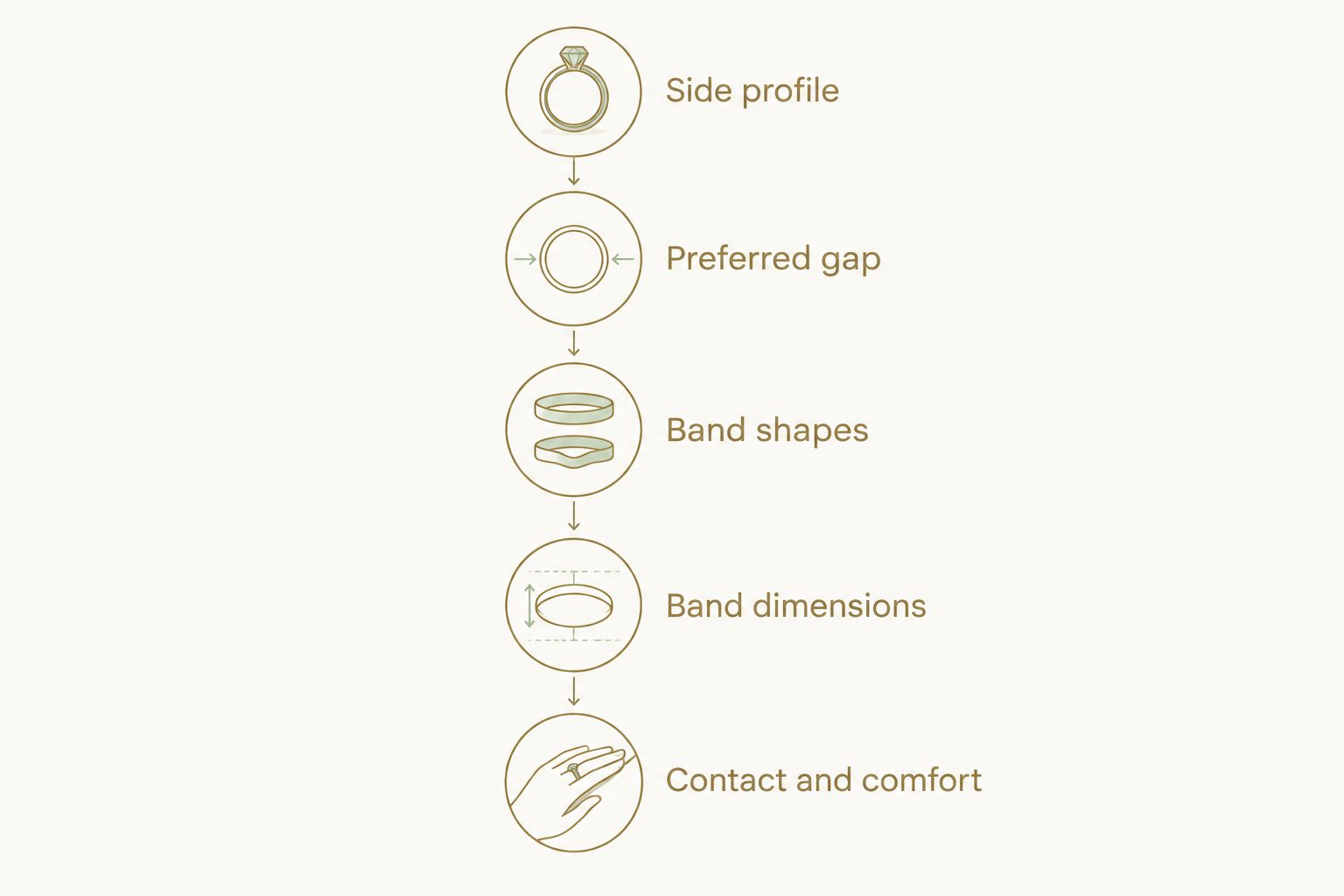
Use this sequence before you commit to a wedding band. If you are still choosing your engagement ring, Ava Lee Diamonds offers lab-grown diamond engagement rings with customizable ring-building options; consider the eventual pair while making those choices.
- Inspect the side profile. Find the basket, the structure supporting the center diamond, and check whether it extends into the space a wedding band would occupy.
- Choose your preferred gap. Decide whether you want the bands close together or prefer visible separation. A gap is a design choice, not automatically a fitting problem.
- Compare band shapes. Start with a straight band, then consider a curved or notched design if the setting obstructs it.
- Check width and thickness. Width is the surface you see from above; thickness is the depth of the band. Both affect how the rings sit together.
- Confirm contact and comfort. Ask for a side-view assessment of the actual pair, then check the wedding band’s suitability for wearing alone.
A top-down photo answers a style question. A side view answers a fit question. Do not treat a coordinated appearance as proof that the rings are compatible.
Why this matters
An oval describes the diamond’s outline, not the shape of the structure underneath it. Two oval engagement rings can therefore need different wedding-band profiles, even when their center stones look similar from above.
For your 2026 purchase, compare the actual setting rather than copying a photographed pairing. A band that looks balanced beside one oval can leave an unwanted gap or touch the setting beside another.
Straight wedding bands: best for a simple, independent look
A straight wedding band gives you an uninterrupted line beside the oval. It also keeps its familiar shape when worn without the engagement ring.
The trade-off is clearance. If the oval’s basket projects beyond the engagement-ring shank, the straight band can meet that structure before the shanks sit close together. Choosing a thinner-looking band does not necessarily solve this: its thickness and stone settings also matter.
Choose a straight band when the actual pair clears comfortably, or when you like the gap it creates. Do not select it solely because the engagement ring is described as high-set; ask to see where the band would sit beneath the center setting.
Curved wedding bands: best for following the oval’s outline
A curved band bends around the center setting rather than continuing directly across its path. It suits shoppers who want the wedding band to echo the oval’s rounded outline.
The curve must match the setting, not just the diamond shape. A shallow curve and a deep curve create different amounts of space, and neither guarantees a close fit without checking the dimensions.
The compromise appears when you wear the wedding band alone: its contour remains visible. Choose a curved band because you like both its paired appearance and its standalone shape.
Notched wedding bands: best for a defined fitting point
A notched band includes a recess intended to accommodate part of the engagement-ring setting. It offers another way to bring the bands closer where a straight profile meets an obstruction.
That recess makes fit especially specific. Its position and dimensions need to correspond to the engagement ring, and the notch remains part of the design when you wear the band alone.
Choose a notched band only after checking it against the actual setting. A product description that says it fits an oval is not enough to establish compatibility with your oval.
Compare the main wedding-band shapes
| Band shape | Best for | Main benefit | Main trade-off | Check before buying |
|---|---|---|---|---|
| Straight | A simple band you also want to wear alone | An uninterrupted outline | Can leave a gap beside a projecting basket | Side-profile clearance |
| Curved | Following the center setting’s outline | Creates space around the setting | The curve remains visible alone | Curve depth and position |
| Notched | Accommodating a specific obstruction | Places a recess where it is needed | Fit depends on the particular setting | Notch dimensions and contact |
These are starting points, not compatibility guarantees. The best wedding band is the one whose shape works with your setting and whose appearance you still like away from it.
Why wedding-band fit varies
When comparing wedding bands for an oval lab grown diamond ring in 2026, focus on these physical differences:
- Basket projection: The supporting structure can occupy space beside the engagement-ring shank.
- Setting height: Clearance depends on where the adjacent band passes, not simply how high the diamond appears.
- Band width: A wider wedding band changes the combined footprint across your finger.
- Band thickness: A deeper profile can meet a basket that a lower-profile band clears.
- Stone and prong placement: Raised details change where the rings touch.
- Ring size and movement: Assess how the rings sit during wear, not only when arranged for a photograph.
Match the wedding band to the complete setting, not the oval outline alone. Lab-grown origin does not determine the space beneath the diamond; the ring’s construction does.
How should you match metal, width, and sparkle?
Start with your visual priority. If you want the oval to remain the focus, compare a plain band with a restrained stone-set design. If you want the wedding band to make its own statement, compare a broader or more detailed band without assuming that more detail means a better pairing.
Matching metal color creates continuity. Mixed metals create contrast. Neither choice establishes physical compatibility, and a shared color does not mean the rings have identical alloy specifications.
For your 2026 shortlist, record the exact metal description rather than writing only “gold.” Then compare the pair from above and from the side, looking at the balance between the oval, the engagement-ring shank, and the wedding band.
A useful test is to cover the wedding band in the photograph, then uncover it. Does it add the effect you want, or pull attention away from the center stone? There is no required width ratio to follow.
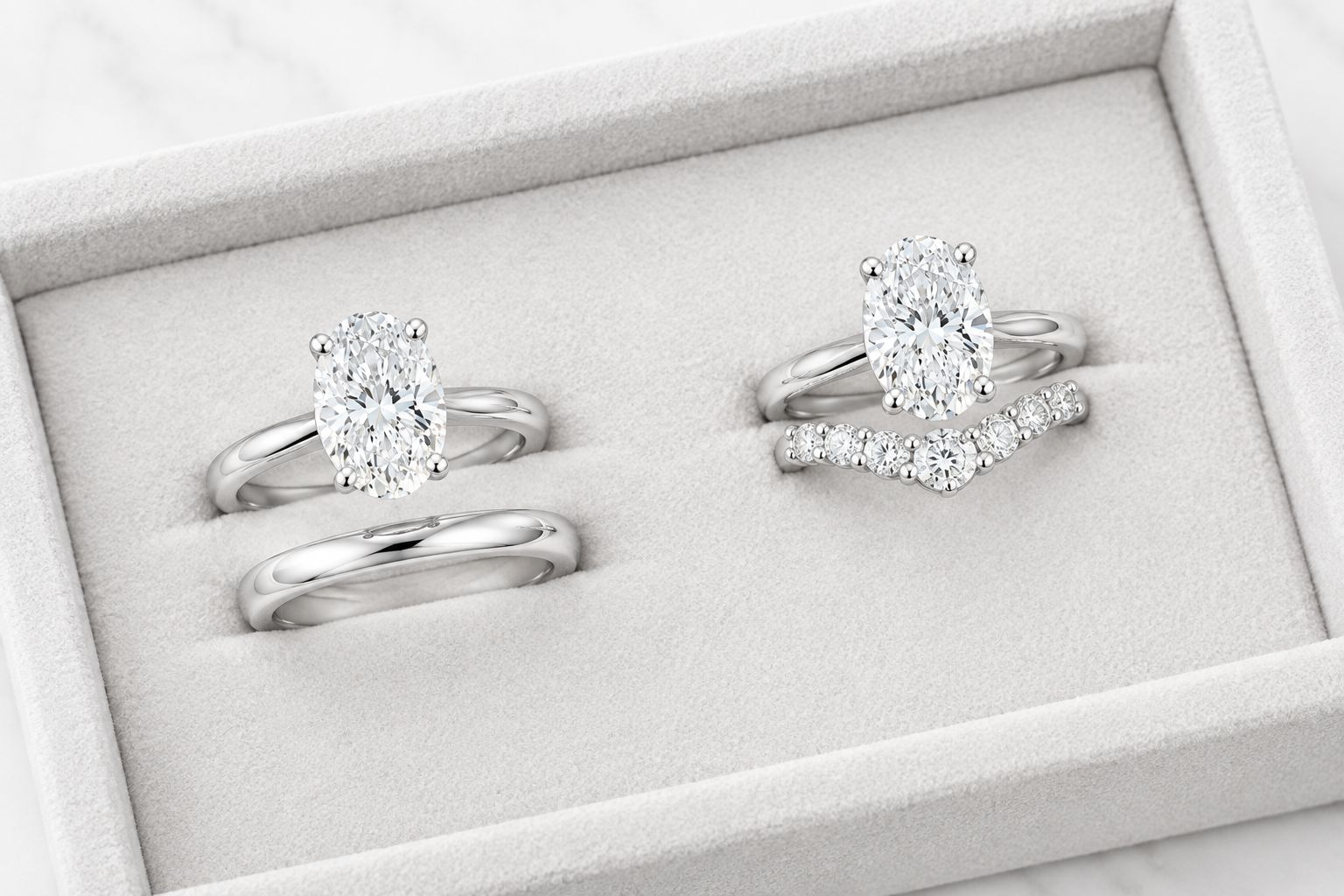
Can an eternity band work with an oval engagement ring?
An eternity band can work with an oval engagement ring when its profile clears the setting and the combined rings feel comfortable. Stone coverage does not answer the fit question; check the band’s edges and settings where they approach the engagement ring.
Ava Lee Diamonds lists the following natural-diamond eternity bands. Their diamond origin differs from a lab-grown center stone, so keep that distinction explicit when comparing your choices.
| Product | Verified construction | Best for | Trade-off to assess |
|---|---|---|---|
| 1 3/8 ctw Natural Diamond Round Three-Row Pavé Domed Eternity Band in 14K Rose Gold | Three rows of pavé over a softly domed band and curved edges | Shoppers seeking rose gold and a detailed wedding band | Check the domed, stone-set edges against the engagement setting |
| 1 3/8 ctw Natural Diamond Round Three-Row Pavé Domed Eternity Band in 14K Yellow Gold | Three rows of pavé over a softly domed band and curved edges | Shoppers seeking yellow gold and a detailed wedding band | Check the combined width and side-profile clearance |
Both titles specify 1 3/8 ctw, meaning the combined diamond weight rather than the weight of a single stone. Both specify 14K gold and 3 rows of pavé. Those details describe the bands; they do not establish their dimensions or compatibility with your engagement ring.
Consider these bands if you want the wedding ring to contribute substantial visual detail. If your priority is a quiet background for the oval, compare that preference against their multirow design before deciding.


What should you check before ordering online in 2026?
Prepare a short comparison sheet for your final wedding-band candidates. Record the engagement ring’s setting details alongside each band, rather than judging separate product photographs from memory.
Ask the seller to confirm:
- The wedding band’s width and thickness.
- Whether the proposed pair has been checked together from the side.
- Where the wedding band touches the engagement ring.
- Whether stones or prongs meet the neighboring ring.
- The sizing and resizing terms for the exact design.
- The applicable return, alteration, and warranty terms.
Send a clear side photograph of your engagement ring if you already own it. Include any dimensions you have, and ask a specific question: will this band clear this basket without contacting the center diamond or its supporting prongs?
Spend according to the complete pair you want to wear. If a larger center stone is your priority, consider the wedding-band design alongside it rather than treating the band as an afterthought. Ava Lee Diamonds offers customizable lab-grown diamond engagement rings, but customization alone does not establish compatibility with a particular band.
FAQ
What’s the best wedding band for an oval lab grown diamond ring?
The best wedding band for an oval lab grown diamond ring clears the setting, feels comfortable, and gives you the appearance you want. Start with a straight band, then compare curved or notched shapes if the basket obstructs it.
Does an oval engagement ring need a curved wedding band?
An oval engagement ring does not automatically need a curved wedding band. A straight band works when the setting provides clearance or when you prefer the resulting gap.
Should my wedding band sit flush with my oval ring?
Your wedding band does not have to sit flush with your oval ring. Choose a close fit or a visible gap according to your preference, but check that the band does not press against the center diamond or its supporting prongs.
Can I wear a natural-diamond wedding band with a lab-grown engagement ring?
You can pair a natural-diamond wedding band with a lab-grown engagement ring. Diamond origin does not determine setting clearance; compare the band’s construction and confirm the origin stated for each piece.
Does my wedding band have to match my engagement ring’s metal?
Your wedding band does not have to match your engagement ring’s metal color. Matching creates continuity, while mixed metals create contrast; confirm each ring’s exact metal specification separately.
Can I choose a wider wedding band than my engagement ring?
You can choose a wedding band wider than your engagement-ring shank. Compare the combined footprint and comfort rather than following a fixed width ratio.
How do I check whether a wedding band will fit when buying online?
Check online wedding-band fit by comparing dimensions and requesting a side-profile assessment of the actual pairing. A top-down photograph alone does not establish clearance around the basket and prongs.
One last thing
Before completing your 2026 order, look at the wedding band without the engagement ring beside it. A contour that looks right around an oval creates a different silhouette alone, so make sure you want both versions of the ring you are choosing.
Decide whether standalone wear matters before choosing the band’s shape. That preference helps separate a pairing you enjoy in photographs from one you want to wear every day.
