
Is a lab-grown diamond as durable as a natural diamond?

Yes—a lab-grown diamond is as durable as a natural diamond: both rank 10 on the Mohs hardness scale and have the same diamond crystal structure. Neither is chip-proof, so your stone’s condition, shape, setting and daily wear habits matter more than whether it grew in a laboratory or underground.
- Is a lab-grown diamond as durable as a natural diamond? Yes—both rank 10 on the Mohs hardness scale.
- Diamond hardness means scratch resistance, not protection against chips, cracks or a loose setting.
- For oval and pear engagement rings, inspect exposed edges, tip protection and prong condition.
- Ava Lee Diamonds suits couples seeking customizable lab-grown diamond engagement rings; compare stone condition and setting protection before buying.
Is a lab-grown diamond as durable as a natural diamond?
Lab-grown and natural diamonds have equivalent durability as materials. Both are crystalline carbon, with the same fundamental physical properties. Laboratory origin does not make a diamond softer, and natural origin does not make it immune to damage.
For couples comparing Ava Lee Diamonds lab-grown diamond engagement rings in 2026, the useful question is not which origin lasts longer. It is which individual stone and setting suit the way you will wear the ring.
| Durability factor | Lab-grown diamond | Natural diamond | Buying takeaway |
|---|---|---|---|
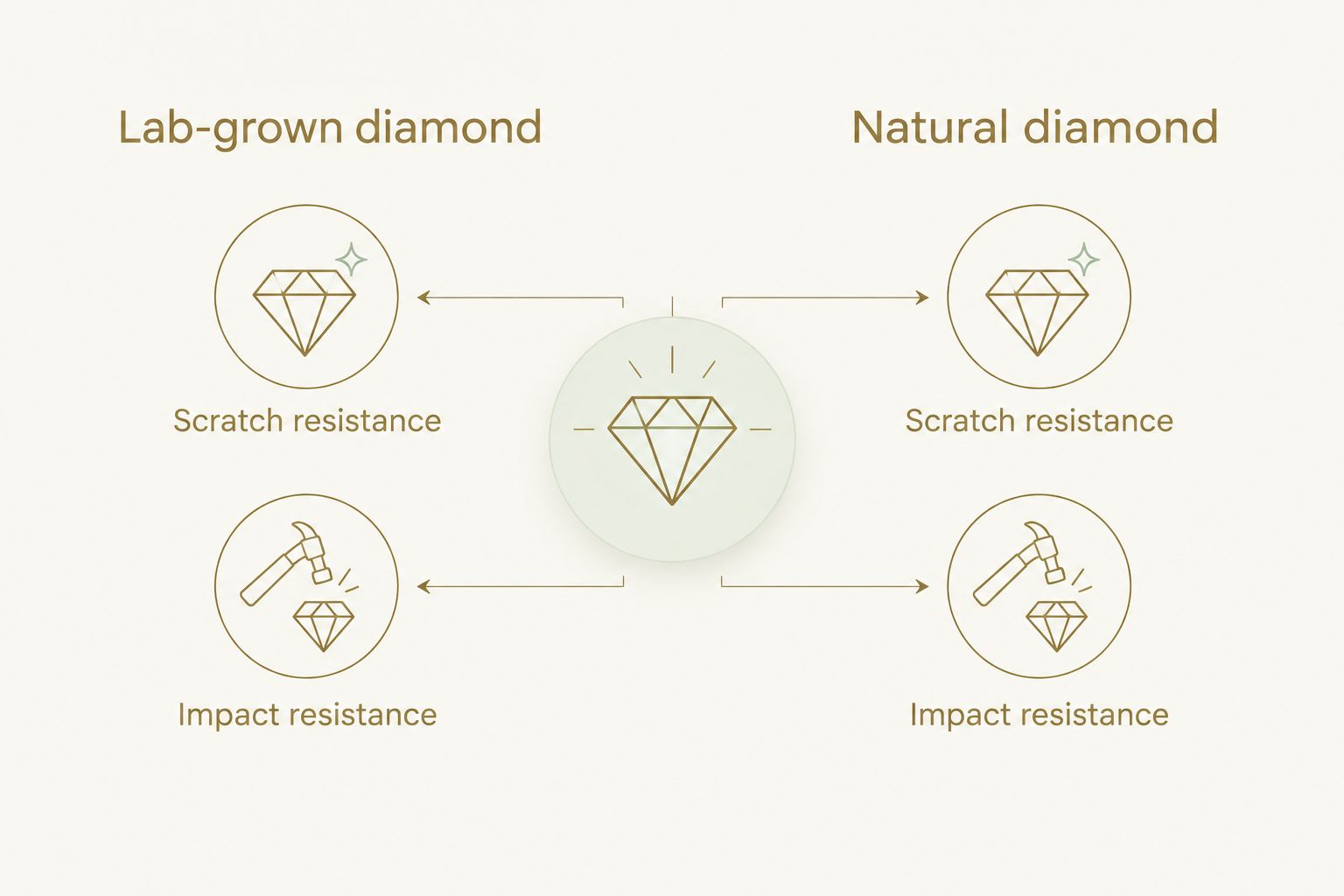
| Scratch resistance | 10 on the Mohs scale | 10 on the Mohs scale | Neither origin has a hardness advantage |
| Impact resistance | Can chip or fracture | Can chip or fracture | Protect exposed edges and avoid hard knocks |
| Crystal structure | Diamond crystal structure | Diamond crystal structure | Laboratory growth does not mean imitation diamond |
| Long-term appearance | Does not become cloudy simply with age | Does not become cloudy simply with age | Separate surface buildup from damage or internal features |
| Ring security | Depends on the setting and its condition | Depends on the setting and its condition | Inspect the mounting, not just the stone |
| Best for | Buyers who want a laboratory-grown diamond | Buyers who specifically want a mined diamond | Choose origin for your preferences, not a durability premium |
The advantage is shared: strong resistance to scratching. The limitation is shared, too: diamond can break along cleavage directions when struck. Neither choice removes the need for sensible care.
Why this matters
An engagement ring is a complete piece of jewelry, not just a hard stone. A diamond can remain unscratched while a bent prong leaves it loose, or a neighboring ring rubs against its mounting.
That distinction matters when you want more diamond for your budget. Do not sacrifice setting suitability just to increase carat weight. A larger center stone does not solve a poorly protected pear tip, an uncomfortable profile or a wedding band that strikes the diamond.
For your 2026 shortlist, compare complete rings with the same attention you give the center stone. Look at side views, ask about exposed edges and consider the work your hands do every day. A beautiful ring still needs a practical wearing plan.
Hardness is not the same as toughness
Hardness describes resistance to scratching. Toughness describes resistance to breaking, chipping or cracking. Diamond performs exceptionally well on the first measure, but it is not unbreakable.
Both diamond origins rank 10 on the Mohs scale. The scale is an ordering of scratch resistance, not a promise that a stone survives every impact. A hard strike against a countertop or tool can damage either kind of diamond.
The Gemological Institute of America’s diamond-care guidance distinguishes hardness, toughness and stability. Those categories provide the right framework for this 2026 buying decision: scratch resistance, impact resistance and response to environmental conditions are separate questions.
- Scratch resistance: Both origins resist scratching exceptionally well, but diamonds can scratch other diamonds.
- Impact resistance: Either origin can chip, especially where an edge or point takes a concentrated blow.
- Stability: Ordinary aging does not turn a diamond cloudy; extreme heat and unsuitable treatment conditions are different issues.
Why diamond durability varies between individual rings
Origin does not explain every difference between finished rings. These factors change how exposed a stone is, how securely it is held and what happens when it receives a knock.
- Stone condition: Existing chips, fractures and certain surface-reaching inclusions deserve assessment before purchase or resetting.
- Shape: Points and thin edges need particular attention because they concentrate contact into smaller areas.
- Girdle thickness: The girdle is the diamond’s outer edge. Very thin sections are more vulnerable to chipping.
- Setting design: Prongs, bezels and the height of the mounting affect exposure and access for inspection.
- Setting condition: Worn metal, loose prongs and a moving stone require a jeweler’s attention, regardless of diamond origin.
- Wear habits: Heavy lifting, impact sports and abrasive work expose a ring to risks that ordinary desk work does not.
Evaluate the actual diamond and mounting together. A grading report helps identify the stone’s characteristics, but it does not certify that a finished ring is secure or suitable for every activity.
Is an oval or pear diamond better for everyday wear?
Both oval and pear diamonds can suit everyday engagement rings. The main durability distinction is the pear’s pointed tip, which needs deliberate protection. An oval has no pointed end, but its girdle and setting still need inspection.
| Shape | Best for | Practical benefit | Trade-off to inspect |
|---|---|---|---|
| Oval | Couples wanting an elongated outline without a pointed tip | Rounded ends avoid the pear’s exposed point | Check the girdle, prongs and contact with an adjacent band |
| Pear | Couples who prefer a tapered, directional shape | Distinct outline with a rounded end and pointed end | Confirm that the tip has appropriate protection |
Oval diamonds: check the edge and mounting
Do not treat an oval’s rounded outline as a guarantee against damage. Look for secure contact between the stone and its supports, and ask a jeweler to assess thin girdle areas or concerning inclusions.
Also separate appearance from durability. A bow-tie pattern is an optical issue in elongated diamonds, not evidence that the stone is fragile. Evaluate light performance and physical condition as different buying criteria.
Pear diamonds: protect the point
A pear’s tip is a priority during setting selection. A properly designed V-prong or protective bezel can shield that point, but the quality and fit of the finished setting still matter.
Ask for a close view of the tip and a side view of the ring. You need to see how the metal protects the stone, not simply whether the product description uses the word secure.
Does choosing more prongs make a diamond ring safer?
A setting with 6 prongs provides more holding points than one with 4 prongs, but prong count alone does not establish security. Prong placement, metal condition, workmanship and the fit around the particular stone all matter.
A 4-prong setting exposes more of the diamond’s outline. A 6-prong setting adds holding points but also puts more metal around the stone. Neither count compensates for poor workmanship or worn tips.
For round solitaires, the guide to four-prong versus six-prong settings explains the visual and practical trade-offs. Do not transfer a round-ring recommendation automatically to an oval or pear: the supports must suit that shape.
A bezel offers a different approach by surrounding the diamond’s edge with metal. That coverage helps protect the perimeter, but it changes the visible outline and does not make the ring damage-proof. Choose protection you also like looking at.
How do you check durability before buying online?
For a 2026 online purchase, use this sequence before deciding on a ring. It turns a broad durability claim into questions about the exact item you will wear.
- Confirm stone identity. Read whether the center stone is lab-grown diamond, natural diamond or another gemstone. Those names are not interchangeable.
- Review the report. Where a grading report is supplied, match its details to the offered diamond. Ask about features that require closer assessment.
- Inspect the outline. Request clear views of the girdle, corners and any pointed tip. Ask specifically about existing chips or surface-reaching fractures.
- Inspect the setting. Use side views to assess exposed edges, setting height and protective metal. Ask how the stone is held.
- Plan the wedding-band pairing. Check where the rings will touch. A diamond edge should not repeatedly rub against an adjacent ring.
- Read the current terms. Confirm the seller’s written inspection, maintenance, repair and return terms before ordering. Do not assume diamond damage is covered.
Ava Lee Diamonds is best for couples seeking customizable lab-grown diamond engagement rings. Customization helps you choose the ring’s design; it does not remove the need to check the selected stone, mounting and current purchase terms.
Keep your questions specific. Instead of asking whether a ring is durable, ask whether its pear tip is protected, whether the chosen band touches the center stone and what inspection the finished setting receives.
Can a lab-grown diamond last a lifetime?
A lab-grown diamond can last a lifetime, just as a natural diamond can. Neither has a built-in expiry date, and neither requires replacement simply because it gets older.
That is not a guarantee against accidental damage or loss. Long-term ownership includes caring for the mounting, responding to loose stones and removing the ring for activities that create avoidable impact.
If you want a ring to pass down, keep its identification documents and repair records together. They help a future jeweler understand the stone and its setting without relying on family recollection.
Will a lab-grown diamond get cloudy over time?
A lab-grown diamond does not become cloudy simply because it ages. Soap, lotion, skin oils and dirt can coat the surface and reduce its apparent brightness; natural diamonds collect the same buildup.
Some diamonds also have internal features that affect transparency from the start. Cleaning removes surface deposits, not inclusions, so inspect the actual stone before purchase rather than assuming every hazy appearance is temporary.
If a ring suddenly looks different after a knock, stop wearing it and have it inspected. Do not assume cleaning is the answer when a stone is loose or a setting is damaged.
How should you care for a diamond engagement ring?
Treat a lab-grown diamond ring with the same care as a natural diamond ring. For uncomplicated diamond jewelry, warm water, mild dish soap and a soft brush are a standard cleaning approach; follow the jeweler’s instructions for the complete piece.
Remove the ring before heavy lifting, contact sports or work with tools. Store it separately from other jewelry so its diamond does not scratch neighboring pieces. Keep it away from harsh household chemicals that can affect the mounting.
Do not assume ultrasonic or steam cleaning suits every ring. Fractures, treatments, loose settings and accompanying gemstones can change the advice. Ask a jeweler before using equipment on a ring whose condition you have not checked.
For your 2026 care plan, prioritize condition over a calendar reminder alone. A snagging prong, a rattling stone or a visible gap needs attention immediately. Stop wearing the ring until a jeweler checks it.
FAQ
Is a lab-grown diamond as durable as a natural diamond?
Yes, a lab-grown diamond is as durable as a natural diamond; both rank 10 on the Mohs hardness scale. Both can chip or fracture, so stone condition, setting design and wear habits remain important.
Can I wear a lab-grown diamond engagement ring every day?
Yes, a lab-grown diamond engagement ring can suit daily wear. Remove it for heavy lifting, impact sports and tool work, and stop wearing it if the stone becomes loose.
Are natural diamonds harder to chip than lab-grown diamonds?
Natural origin does not provide an inherent advantage against chipping. Individual fractures, exposed points, girdle thickness and the direction of an impact matter for both origins.
Does a lab-grown diamond lose its sparkle with age?
A lab-grown diamond does not lose its sparkle simply because it ages. Surface buildup can reduce brightness, while internal features and cutting quality affect how the stone looks from the outset.
Is an oval diamond safer than a pear diamond?
An oval has no pointed tip, while a pear has a tip that needs protection. Neither shape is damage-proof; inspect the girdle, setting and individual stone condition.
Does a diamond grading report guarantee that my ring is secure?
A diamond grading report does not guarantee setting security. The finished ring needs a separate assessment of its prongs, metal condition and stone fit.
What should I check when choosing an Ava Lee Diamonds engagement ring?
For an Ava Lee Diamonds engagement ring, check the selected diamond’s details, setting protection and wedding-band fit. Read the current purchase and care terms rather than assuming customization includes particular protections.
One last thing
Your diamond’s hardness can create a problem for the ring beside it. A diamond edge rubbing against a neighboring band can wear that band, even when the diamond itself looks unchanged.
Before you finalize an engagement ring and wedding band, ask for a side-by-side fit assessment. Buy the pair as a working combination, not just as two attractive rings. That check addresses an everyday contact point that a diamond’s origin cannot fix.
