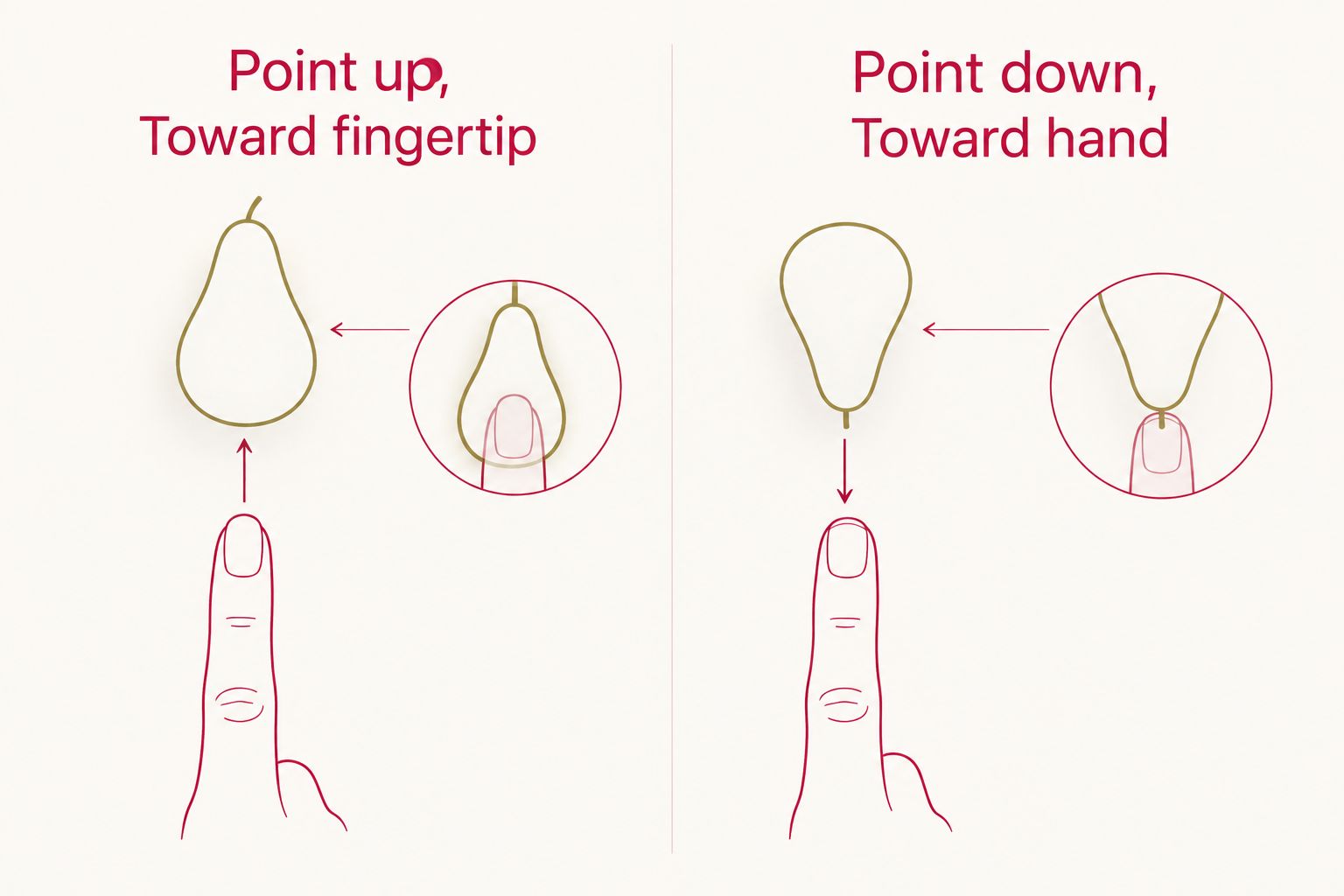
Wear a pear-shaped diamond point up toward your fingertip or point down toward your hand; neither direction is required. For a pear shaped lab grown diamond ring, choose the orientation you prefer on your own finger, then check comfort, tip protection, and how the ring sits beside your wedding band.
- A pear shaped lab grown diamond ring can face either direction; choose by appearance, comfort, and wedding-band fit.
- Point up means toward your fingertip; point down means toward your hand.
- Ava Lee Diamonds serves couples shopping for customizable lab-grown diamond engagement rings.
- Protect the pointed tip with a suitable setting; reversing the ring does not replace protection.
Why this matters
A pear's pointed end makes direction noticeable in a way that a round diamond's outline does not. But direction is a styling decision, not a test of whether you are wearing your engagement ring correctly.
Ava Lee Diamonds is best for couples seeking customizable lab-grown diamond engagement rings. When you explore Ava Lee Diamonds, separate the look you want from the construction questions you need answered before ordering. Customization should help you choose a ring you enjoy wearing, not add rules about which way it must face.
For your 2026 engagement-ring purchase, settle orientation before approving an asymmetric design or choosing a fitted wedding band. That keeps the decision connected to the complete ring rather than an isolated diamond photograph.
Should you wear a pear-shaped diamond point up or down?
Either direction is correct. Here, point up means the tip faces your fingernail; point down means the tip faces the base of your finger and your hand. These descriptions stay clear even when you turn your hand or look at a photograph taken from another angle.
| Orientation | Where the tip faces | Best for | Benefit | Trade-off |
|---|---|---|---|---|
| Point up | Toward fingertip | Shoppers who prefer the taper facing the nail | Places the narrow end toward the end of your finger | The rounded end sits closer to a band worn below the engagement ring |
| Point down | Toward hand | Shoppers who prefer the taper facing the knuckle | Reverses the outline without changing the diamond | The pointed end sits closer to a band worn below the engagement ring |
The table describes the arrangement, not a guarantee of comfort or a flush fit. The height of the setting and the shape of the neighboring band determine whether the rings touch.
You can reverse many standalone rings simply by taking them off and putting them back on the other way. Check the whole design first: an attached band, asymmetric setting, or fitted stack can make the two orientations feel different.
Point up: best for a taper facing your fingertip
Choose point up if you like seeing the diamond narrow toward your nail. The broader, rounded end then faces the base of your finger. This gives you a clear starting arrangement when trying on a pear for the first time.
The advantage is visual simplicity: the tip follows the direction of your finger. The limitation is that this preference says nothing about whether a particular setting feels comfortable, catches on clothing, or leaves room for your wedding band.
Try point up first, but do not treat it as a rule. Look at your relaxed hand rather than only a posed close-up. If the ring looks right only when you stretch your fingers for a photograph, compare the other direction before deciding.
For a 2026 online purchase, request an on-hand view with the tip toward the fingertip. A product photograph without a hand does not show how the outline relates to your finger.
Point down: best for a taper facing your hand
Choose point down if you prefer the narrow end facing your knuckle and the rounded end facing your nail. There is no requirement to justify that choice with a symbolic meaning. Your preference is enough.
This orientation changes which end of the pear sits beside a wedding band worn closer to your hand. That makes it useful to test with the actual band shape you want, especially when the band curves around the engagement ring.
The benefit is a different visual balance using the same diamond. The trade-off is that a fitted band designed around the rounded end will not necessarily follow the pointed end when you reverse the engagement ring.
Choose point down when you prefer the complete arrangement, not just the diamond by itself. If you plan to wear the engagement ring alone sometimes, check that you still like its direction without the wedding band beside it.
Why your preferred pear-ring direction varies
The right direction depends on the ring and how you wear it. These factors deserve more attention than an etiquette rule:
- Outline preference. Decide whether you like the taper facing your nail or the base of your finger. Neither changes the diamond's actual dimensions.
- Wedding-band placement. A band beside the rounded end creates a different arrangement from a band beside the tip. Check both together.
- Setting construction. The basket, prongs, and any asymmetric details determine how the complete ring sits when reversed.
- Tip protection. A pear's pointed end needs suitable protection from impact. Direction alone does not provide that protection.
- Daily comfort. Check whether the setting presses against nearby fingers, catches on fabric, or interferes with the neighboring band.
For your 2026 shortlist, use the same criteria for every ring. Comparing one ring in isolation with another shown in a finished stack makes it harder to identify what you actually prefer.
How do you choose the direction before buying online?
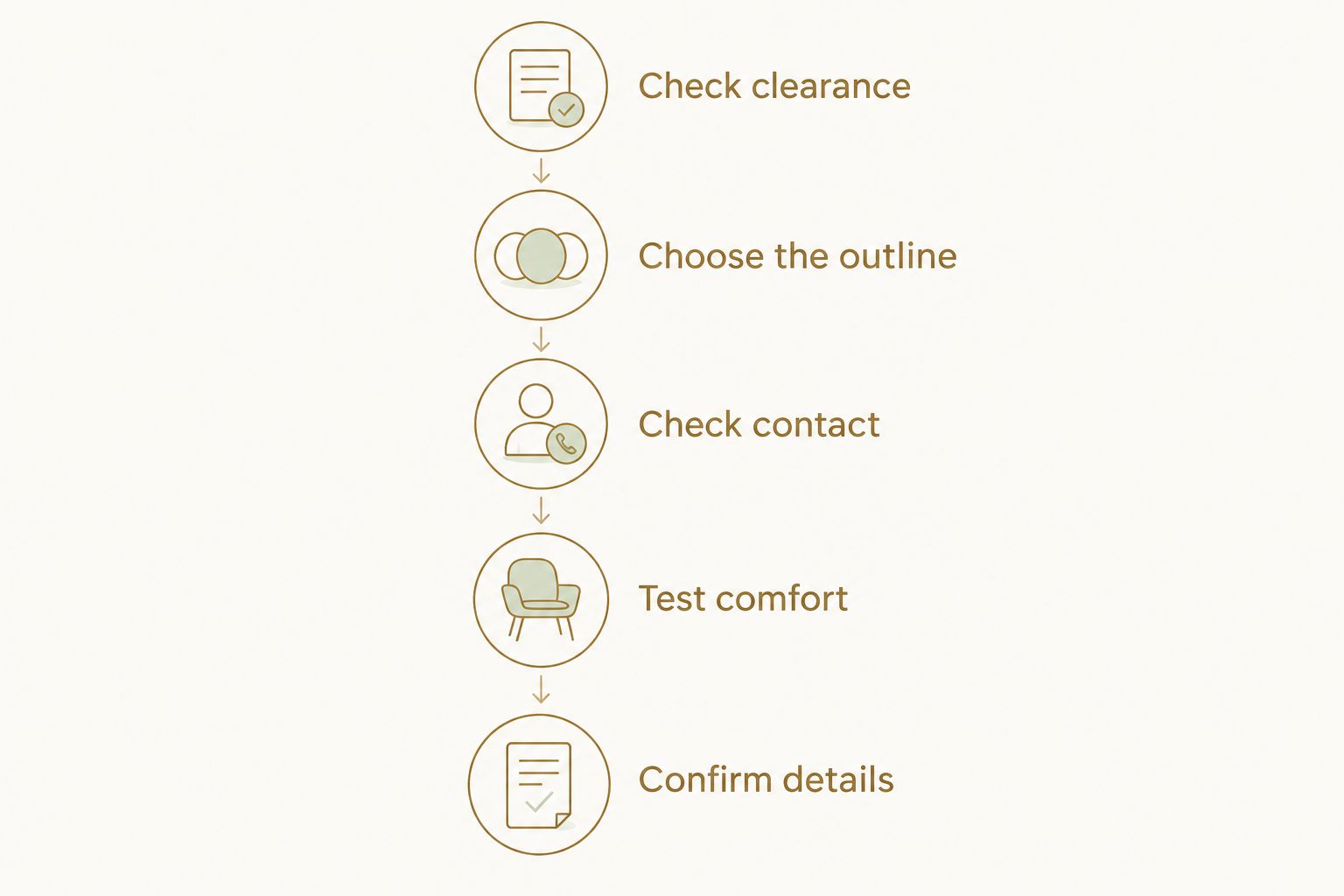
Use this sequence before approving your ring. The goal is to compare like with like, then ask about anything a photograph cannot establish.
- Define the direction. Write “tip toward fingertip” or “tip toward hand” in your notes. Avoid relying on “up” in a screenshot that someone else might rotate.
- Compare matching views. Ask for face-up and side views of the same setting. Keep the hand position and image scale consistent when comparing orientations.
- Add the wedding band. Request a view with the band in its intended position. Look for contact between the band, the diamond's tip, and the engagement-ring setting.
- Check the tip. Ask how the setting protects the pointed end. A V-shaped prong or a bezel can protect that area, but the exact construction still matters.
- Confirm the complete design. Before ordering, check the selected diamond, metal, ring size, setting, and any customization instructions. Make sure an orientation request is understood in relation to the finger.
An image can establish your styling preference; it cannot establish that a stone is secure. Ask the seller to explain the construction rather than treating a polished photograph as proof of durability.
If you already own the ring, compare both directions on your hand without bending or adjusting any metal. Have a jeweler assess loose stones, damaged prongs, or persistent snagging instead of trying to correct them yourself.
Does the direction change how large a pear diamond looks?
Reversing a pear diamond does not change its length, width, or carat weight. It changes how the outline sits relative to your finger. You can prefer that visual effect without assuming the diamond has become larger.
For a 2026 comparison, ask for the diamond's length and width in millimeters rather than judging size from carat weight alone. Carat measures weight, not face-up dimensions: 1 carat equals 200 milligrams, while 0.5 carat equals 100 milligrams. Diamonds of equal weight can have different face-up measurements.
This distinction helps you keep budget decisions separate from styling decisions. Choose a visible outline you like, then evaluate the individual diamond's appearance and setting rather than paying for weight you cannot assess from the image.
A pear's proportions also affect its outline. A longer, narrower pear and a shorter, broader pear will not look identical just because both point toward the fingertip. Compare actual stones, not only generic shape drawings.
Is point up safer than point down?
Neither orientation substitutes for a protective setting. A pointed diamond tip is vulnerable to damage from an impact, so ask how the setting shields it and whether the surrounding metal is secure.
A V-shaped prong covers the tip, while a bezel surrounds the stone's edge with metal. Both change how much metal you see around the diamond. Evaluate that appearance alongside the protection the specific design provides rather than choosing by the setting name alone.
Do not assume reversing a snagging ring solves the underlying issue. A raised or damaged prong needs inspection. If a wedding band rubs against the engagement-ring setting, ask a jeweler to assess the pair before continuing to wear them together.
Does point down mean something different from point up?
Neither direction has a universal meaning you must follow. You can give the orientation a personal meaning, but it does not determine whether the ring is appropriate as an engagement ring.
If you are choosing a surprise ring, prioritize the recipient's preferences over a claimed symbolism rule. Look at jewelry they already wear or discuss pear shapes together. A preference for pointed outlines does not automatically tell you which direction they will choose.
What should you check besides orientation?
For a pear-shaped engagement ring, the direction is only one part of the purchase. Keep these checks on your 2026 buying list:
- Diamond appearance: Review the actual stone in motion where possible. Look for distracting dark areas, including the central bow-tie pattern associated with elongated shapes.
- Setting details: Confirm how the tip is protected and how the ring looks from the side, not just directly above.
- Wearability: Consider how the ring fits your everyday activities and whether the setting catches against nearby items.
- Complete specifications: Distinguish the center diamond's weight from any total carat weight that includes accent stones.
- Order terms: Read the current customization, return, resizing, and warranty terms before committing. Do not assume different sellers apply the same rules.
Ava Lee Diamonds offers customizable ring-building options for couples and individuals. Use that control to clarify the design you want; the trade-off is that you need to confirm the selected details before ordering rather than relying on a general category description.
FAQ
Which way should a pear shaped lab grown diamond ring face?
A pear shaped lab grown diamond ring can face toward your fingertip or toward your hand. Choose the direction you prefer, then check comfort, tip protection, and wedding-band fit.
Is it wrong to wear a pear-shaped engagement ring point down?
No, wearing a pear-shaped engagement ring point down is not wrong. There is no required orientation; point down simply places the tip toward the base of your finger.
Can I turn my pear-shaped ring around whenever I want?
You can reverse a standalone ring if its complete design fits comfortably both ways. Attached bands, asymmetric details, and fitted wedding bands need a separate fit check.
Does a lab-grown pear diamond need a different orientation from a mined diamond?
No, a lab-grown pear diamond does not require a different wearing direction. The choice depends on the pear outline, setting, comfort, and your preference rather than the diamond's origin.
Does pointing a pear diamond upward make it bigger?
Pointing a pear diamond upward does not change its dimensions or carat weight. Compare its length and width in millimeters to understand its face-up size.
Should the wedding band sit beside the tip or the rounded end?
Either arrangement works if the rings fit together without harmful contact. Try the complete stack and have a jeweler assess any rubbing against the diamond or setting.
One last thing
Choose the wedding-band arrangement before finalizing an asymmetric ring design. You can reverse a standalone engagement ring, but a contour made to follow one end of a pear will not necessarily follow the other.
Keep a reference image showing your preferred direction and band placement with your order notes. That gives you a clear design reference without turning a personal styling choice into a permanent wearing rule.