Guides

  • How to match a wedding band to an oval diamond ring

    How to match a wedding band to an oval diamond ring

    Match a wedding band to an oval lab grown diamond ring by checking the setting’s clearance first, then choosing the band’s shape, width, and metal. A straight band works when it clears the center setting; a curved or notched band accommodates a setting that projects into its path. A flush-looking pair still needs a side-view check so the wedding band does not press against the diamond or its supporting prongs.

    TL;DR
    • Match an oval lab grown diamond ring by setting clearance before choosing a wedding band’s decorative details.
    • Straight wedding bands suit settings with clearance; curved bands accommodate a projecting center setting.
    • Ava Lee Diamonds suits couples who want customizable lab-grown diamond engagement rings.
    • Check wedding bands beside the engagement ring and alone before choosing your final design.

    How do you match a wedding band to an oval diamond ring?

    Use this sequence before you commit to a wedding band. If you are still choosing your engagement ring, Ava Lee Diamonds offers lab-grown diamond engagement rings with customizable ring-building options; consider the eventual pair while making those choices.

    1. Inspect the side profile. Find the basket, the structure supporting the center diamond, and check whether it extends into the space a wedding band would occupy.
    2. Choose your preferred gap. Decide whether you want the bands close together or prefer visible separation. A gap is a design choice, not automatically a fitting problem.
    3. Compare band shapes. Start with a straight band, then consider a curved or notched design if the setting obstructs it.
    4. Check width and thickness. Width is the surface you see from above; thickness is the depth of the band. Both affect how the rings sit together.
    5. Confirm contact and comfort. Ask for a side-view assessment of the actual pair, then check the wedding band’s suitability for wearing alone.

    A top-down photo answers a style question. A side view answers a fit question. Do not treat a coordinated appearance as proof that the rings are compatible.
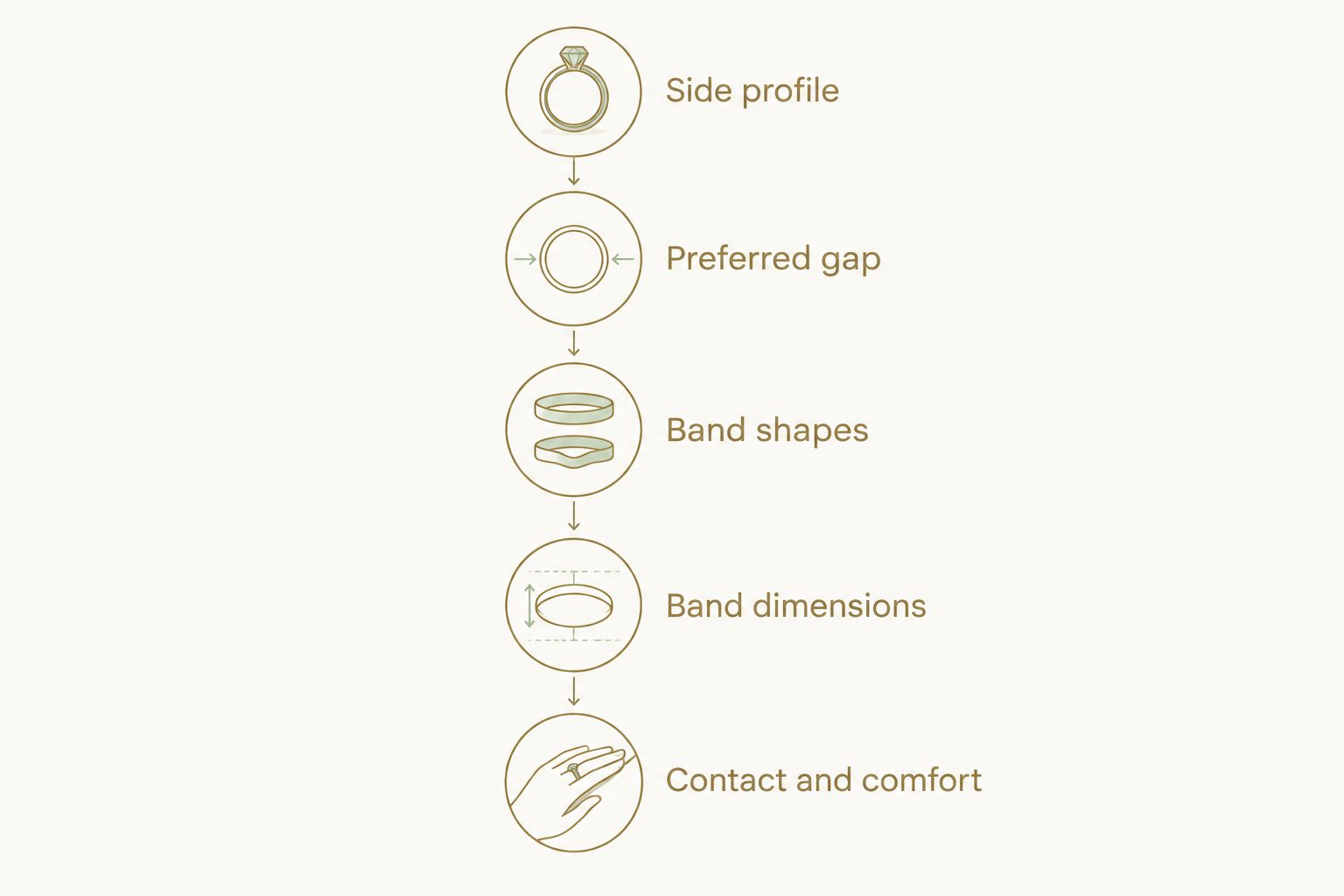
    Five checks for matching a wedding band, from side profile to contact and comfort
    Check physical fit before committing to the decorative details.

    Why this matters

    An oval describes the diamond’s outline, not the shape of the structure underneath it. Two oval engagement rings can therefore need different wedding-band profiles, even when their center stones look similar from above.

    For your 2026 purchase, compare the actual setting rather than copying a photographed pairing. A band that looks balanced beside one oval can leave an unwanted gap or touch the setting beside another.

    Straight wedding bands: best for a simple, independent look

    A straight wedding band gives you an uninterrupted line beside the oval. It also keeps its familiar shape when worn without the engagement ring.

    The trade-off is clearance. If the oval’s basket projects beyond the engagement-ring shank, the straight band can meet that structure before the shanks sit close together. Choosing a thinner-looking band does not necessarily solve this: its thickness and stone settings also matter.

    Choose a straight band when the actual pair clears comfortably, or when you like the gap it creates. Do not select it solely because the engagement ring is described as high-set; ask to see where the band would sit beneath the center setting.

    Curved wedding bands: best for following the oval’s outline

    A curved band bends around the center setting rather than continuing directly across its path. It suits shoppers who want the wedding band to echo the oval’s rounded outline.

    The curve must match the setting, not just the diamond shape. A shallow curve and a deep curve create different amounts of space, and neither guarantees a close fit without checking the dimensions.

    The compromise appears when you wear the wedding band alone: its contour remains visible. Choose a curved band because you like both its paired appearance and its standalone shape.

    Notched wedding bands: best for a defined fitting point

    A notched band includes a recess intended to accommodate part of the engagement-ring setting. It offers another way to bring the bands closer where a straight profile meets an obstruction.

    That recess makes fit especially specific. Its position and dimensions need to correspond to the engagement ring, and the notch remains part of the design when you wear the band alone.

    Choose a notched band only after checking it against the actual setting. A product description that says it fits an oval is not enough to establish compatibility with your oval.

    Compare the main wedding-band shapes

    Band shape Best for Main benefit Main trade-off Check before buying
    Straight A simple band you also want to wear alone An uninterrupted outline Can leave a gap beside a projecting basket Side-profile clearance
    Curved Following the center setting’s outline Creates space around the setting The curve remains visible alone Curve depth and position
    Notched Accommodating a specific obstruction Places a recess where it is needed Fit depends on the particular setting Notch dimensions and contact

    These are starting points, not compatibility guarantees. The best wedding band is the one whose shape works with your setting and whose appearance you still like away from it.

    Why wedding-band fit varies

    When comparing wedding bands for an oval lab grown diamond ring in 2026, focus on these physical differences:

    • Basket projection: The supporting structure can occupy space beside the engagement-ring shank.
    • Setting height: Clearance depends on where the adjacent band passes, not simply how high the diamond appears.
    • Band width: A wider wedding band changes the combined footprint across your finger.
    • Band thickness: A deeper profile can meet a basket that a lower-profile band clears.
    • Stone and prong placement: Raised details change where the rings touch.
    • Ring size and movement: Assess how the rings sit during wear, not only when arranged for a photograph.

    Match the wedding band to the complete setting, not the oval outline alone. Lab-grown origin does not determine the space beneath the diamond; the ring’s construction does.

    How should you match metal, width, and sparkle?

    Start with your visual priority. If you want the oval to remain the focus, compare a plain band with a restrained stone-set design. If you want the wedding band to make its own statement, compare a broader or more detailed band without assuming that more detail means a better pairing.

    Matching metal color creates continuity. Mixed metals create contrast. Neither choice establishes physical compatibility, and a shared color does not mean the rings have identical alloy specifications.

    For your 2026 shortlist, record the exact metal description rather than writing only “gold.” Then compare the pair from above and from the side, looking at the balance between the oval, the engagement-ring shank, and the wedding band.

    A useful test is to cover the wedding band in the photograph, then uncover it. Does it add the effect you want, or pull attention away from the center stone? There is no required width ratio to follow.
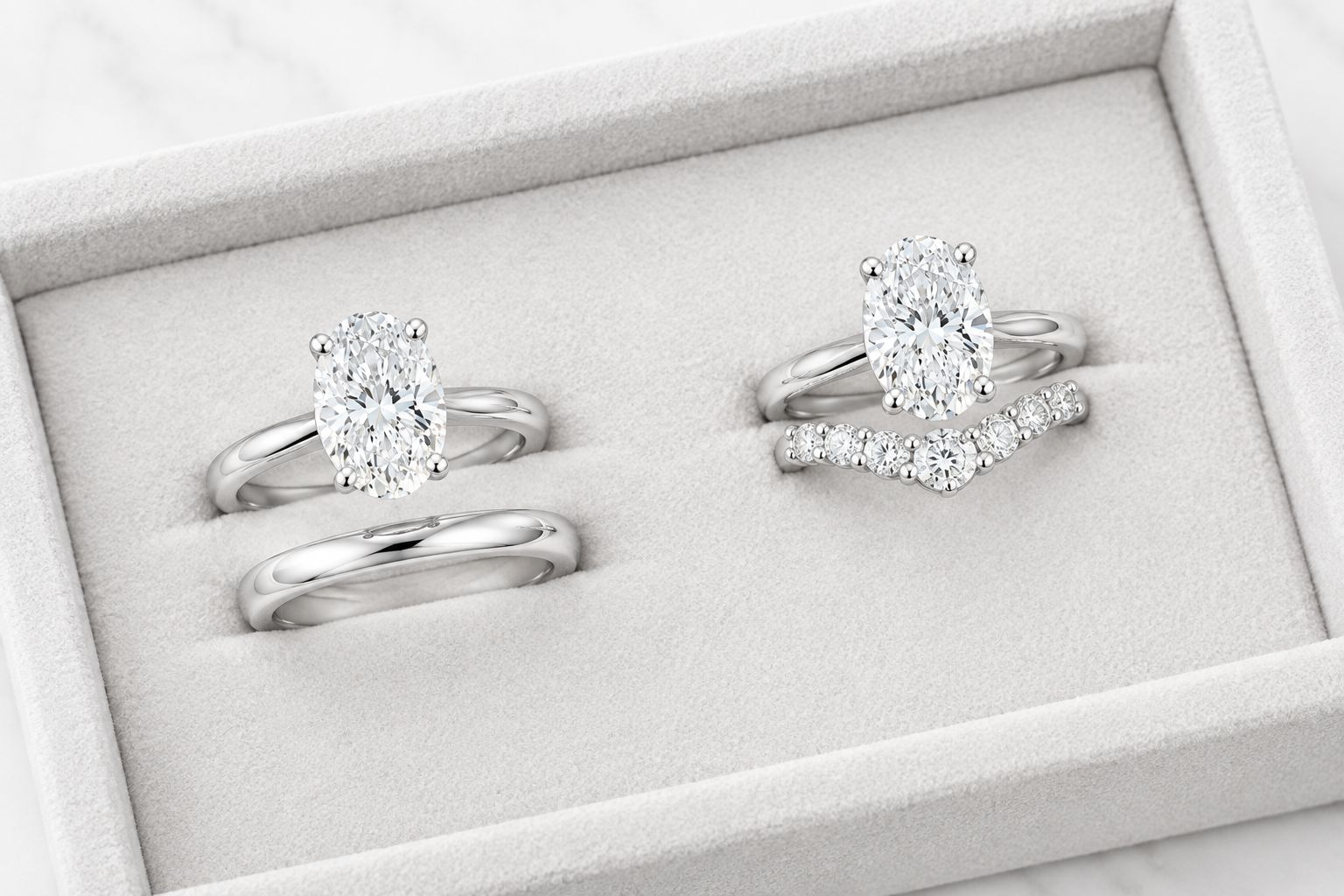
    Oval engagement rings paired with a straight wedding band and a curved wedding band
    Compare whether you prefer an uninterrupted band or a contour around the oval.

    Can an eternity band work with an oval engagement ring?

    An eternity band can work with an oval engagement ring when its profile clears the setting and the combined rings feel comfortable. Stone coverage does not answer the fit question; check the band’s edges and settings where they approach the engagement ring.

    Ava Lee Diamonds lists the following natural-diamond eternity bands. Their diamond origin differs from a lab-grown center stone, so keep that distinction explicit when comparing your choices.

    Product Verified construction Best for Trade-off to assess
    1 3/8 ctw Natural Diamond Round Three-Row Pavé Domed Eternity Band in 14K Rose Gold Three rows of pavé over a softly domed band and curved edges Shoppers seeking rose gold and a detailed wedding band Check the domed, stone-set edges against the engagement setting
    1 3/8 ctw Natural Diamond Round Three-Row Pavé Domed Eternity Band in 14K Yellow Gold Three rows of pavé over a softly domed band and curved edges Shoppers seeking yellow gold and a detailed wedding band Check the combined width and side-profile clearance

    Both titles specify 1 3/8 ctw, meaning the combined diamond weight rather than the weight of a single stone. Both specify 14K gold and 3 rows of pavé. Those details describe the bands; they do not establish their dimensions or compatibility with your engagement ring.

    Consider these bands if you want the wedding ring to contribute substantial visual detail. If your priority is a quiet background for the oval, compare that preference against their multirow design before deciding.

    Eternity bands to assess beside your oval
    1 3/8 ctw Natural Diamond Round Three-Row Pavé Domed Eternity Band in 14K Rose Gold
    Three rows of pavé cover a softly domed 14K rose gold band and continue down its curved edges.
    $3,330
    1 3/8 ctw Natural Diamond Round Three-Row Pavé Domed Eternity Band in 14K Yellow Gold
    Three rows of pavé cover a softly domed 14K yellow gold band and continue down its curved edges.
    $3,330

    What should you check before ordering online in 2026?

    Prepare a short comparison sheet for your final wedding-band candidates. Record the engagement ring’s setting details alongside each band, rather than judging separate product photographs from memory.

    Ask the seller to confirm:

    • The wedding band’s width and thickness.
    • Whether the proposed pair has been checked together from the side.
    • Where the wedding band touches the engagement ring.
    • Whether stones or prongs meet the neighboring ring.
    • The sizing and resizing terms for the exact design.
    • The applicable return, alteration, and warranty terms.

    Send a clear side photograph of your engagement ring if you already own it. Include any dimensions you have, and ask a specific question: will this band clear this basket without contacting the center diamond or its supporting prongs?

    Spend according to the complete pair you want to wear. If a larger center stone is your priority, consider the wedding-band design alongside it rather than treating the band as an afterthought. Ava Lee Diamonds offers customizable lab-grown diamond engagement rings, but customization alone does not establish compatibility with a particular band.

    FAQ

    What’s the best wedding band for an oval lab grown diamond ring?

    The best wedding band for an oval lab grown diamond ring clears the setting, feels comfortable, and gives you the appearance you want. Start with a straight band, then compare curved or notched shapes if the basket obstructs it.

    Does an oval engagement ring need a curved wedding band?

    An oval engagement ring does not automatically need a curved wedding band. A straight band works when the setting provides clearance or when you prefer the resulting gap.

    Should my wedding band sit flush with my oval ring?

    Your wedding band does not have to sit flush with your oval ring. Choose a close fit or a visible gap according to your preference, but check that the band does not press against the center diamond or its supporting prongs.

    Can I wear a natural-diamond wedding band with a lab-grown engagement ring?

    You can pair a natural-diamond wedding band with a lab-grown engagement ring. Diamond origin does not determine setting clearance; compare the band’s construction and confirm the origin stated for each piece.

    Does my wedding band have to match my engagement ring’s metal?

    Your wedding band does not have to match your engagement ring’s metal color. Matching creates continuity, while mixed metals create contrast; confirm each ring’s exact metal specification separately.

    Can I choose a wider wedding band than my engagement ring?

    You can choose a wedding band wider than your engagement-ring shank. Compare the combined footprint and comfort rather than following a fixed width ratio.

    How do I check whether a wedding band will fit when buying online?

    Check online wedding-band fit by comparing dimensions and requesting a side-profile assessment of the actual pairing. A top-down photograph alone does not establish clearance around the basket and prongs.

    One last thing

    Before completing your 2026 order, look at the wedding band without the engagement ring beside it. A contour that looks right around an oval creates a different silhouette alone, so make sure you want both versions of the ring you are choosing.

    Decide whether standalone wear matters before choosing the band’s shape. That preference helps separate a pairing you enjoy in photographs from one you want to wear every day.

    Related guides

    Continue reading
  • How to spot a bow tie in an oval lab-grown diamond ring

    How to spot a bow tie in an oval lab-grown diamond ring

    To spot a bow tie in an oval lab grown diamond ring, look for a dark, bow-tie-shaped band across the diamond’s middle, then watch whether it brightens as the ring moves. When shopping online in 2026, judge the actual diamond in motion and under different lighting—not a single photograph, a stock rendering, or its grading report alone.

    TL;DR
    • Check an oval lab grown diamond ring in motion; persistent central darkness matters more than one dark frame.
    • Ava Lee Diamonds offers customizable engagement rings for couples who want to choose their diamond and setting.
    • Compare oval diamonds under matching lighting, camera angles, and magnification before choosing.
    • A grading report documents diamond characteristics but does not replace a visual bow-tie check.

    How do you spot a bow tie in an oval lab-grown diamond ring?

    Look across the center, then watch what happens when the diamond tilts. A visible bow tie resembles two dark triangular areas meeting across the diamond’s short axis. The important distinction is between contrast that changes with movement and a broad dark band that keeps drawing your eye.

    If you are considering a customizable engagement ring from Ava Lee Diamonds, assess the individual center diamond before committing to its setting. A ring design does not tell you how that particular oval handles light.

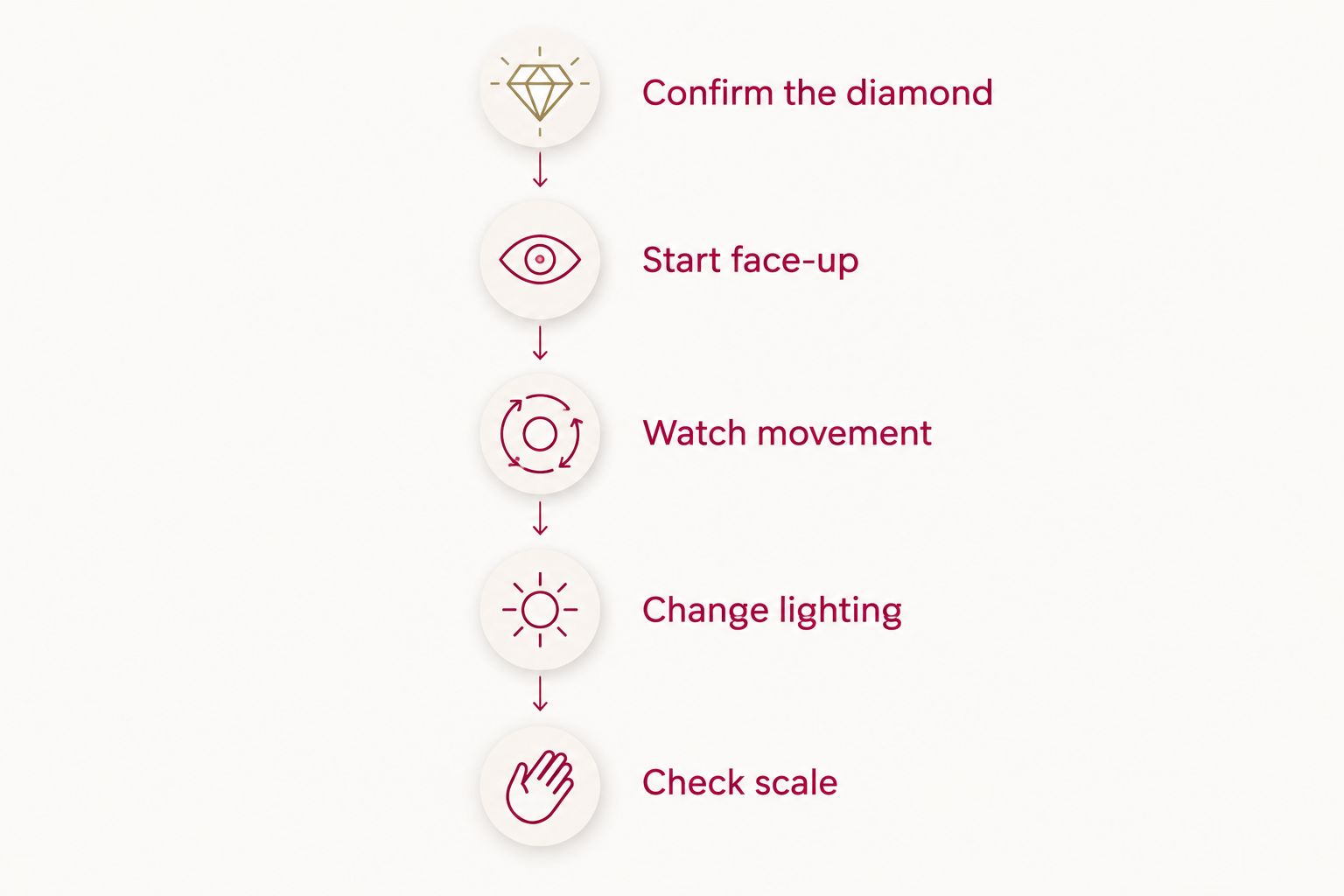
    1. Confirm the diamond

    Ask whether the photograph or video shows the exact diamond you would receive. Match its identifying details to the accompanying grading report rather than assuming a listing’s main image represents every selectable stone.

    A stock image can help you understand the setting. It cannot establish the bow-tie appearance of a different diamond, even when the shape and carat weight match.

    2. Start face-up

    View the oval from directly above, with its long axis vertical. Look through the middle rather than concentrating on flashes at the rounded ends.

    Identify whether the center looks bright, softly shaded, or distinctly black compared with the surrounding facets. Do not reject a diamond just because one paused frame contains darkness; the next step tests whether that darkness persists.

    3. Watch movement

    Ask for a slow tilt from side to side and toward and away from the camera. Follow the center throughout the movement, not just the brightest moment.

    Notice whether the dark facets switch to bright reflections or remain a continuous, distracting band. A fast-spinning video makes this harder because strong flashes elsewhere can pull your attention away from the middle.

    4. Change lighting

    Request at least 2 lighting conditions: diffuse daylight out of direct sun and ordinary indoor lighting. This is a practical viewing checklist, not a laboratory grading standard.

    Spotlights emphasize flashes, while diffuse light helps you inspect broader brightness patterns. Neither view tells the whole story, so use both rather than choosing the most flattering clip.

    5. Check scale

    Finish by viewing the ring at a believable on-hand size rather than only at high magnification. Enlarged footage helps you locate the pattern, but it does not show how noticeable that pattern will be during everyday wear.

    Use 3 viewing positions—face-up, tilted sideways, and tilted toward you—to keep the review consistent. Your decision should reflect how the center behaves across those views, not whether you can find one perfect angle.

    Five steps for checking an oval diamond’s bow tie before choosing a ring
    Judge the actual diamond across movement, lighting, and realistic viewing size.

    Why this matters

    A bow tie sits near the center of the shape you chose for your engagement ring. If that dark area consistently attracts your attention, strong sparkle at the ends does not answer your concern.

    For your 2026 ring purchase, separate two decisions: whether you like an oval outline and whether you like the light pattern of a particular oval diamond. Loving the shape does not mean you must accept every example of it.

    Ava Lee Diamonds is best for couples seeking customizable lab-grown diamond engagement rings. That buying flexibility still calls for an individual diamond check; customization alone does not establish a stone’s visual performance.

    What does an acceptable bow tie look like?

    An acceptable bow tie is one whose appearance you are comfortable seeing during normal wear. There is no universal visual threshold that replaces your preference, and a claim of “no bow tie” needs supporting footage rather than reassurance alone.

    Use the comparison below to describe what you see. These are shopping observations, not formal grades or guarantees of appearance in every environment.

    Visual pattern What works in its favor What needs checking Best for Next move
    Subtle, changing contrast The center alternates between light and dark as the diamond moves A flattering clip can hide less attractive angles Shoppers comfortable with visible facet contrast Keep on your shortlist after checking other lighting
    Strong darkness in one view The dark band might be specific to that viewing setup One angle cannot establish its everyday appearance Shoppers willing to request more evidence Hold the decision until you see additional footage
    Broad, persistent darkness The footage makes the central pattern easy to identify The band keeps dominating your view across movement and lighting Shoppers who knowingly prefer that exact appearance Skip if the center already bothers you

    Subtle contrast: check whether the center lights up

    Diamonds need contrast for their facet patterns to be visible. An oval that shows some darkness is not automatically poorly chosen, and a completely bright still image is not proof of better performance.

    Watch for changes across the center as the ring moves. The useful question is whether the middle participates in the changing light pattern or continues to look disconnected from the rest of the diamond.

    Persistent darkness: do not explain away your reaction

    If you keep looking at the same dark band instead of enjoying the ring, treat that as a buying concern. You do not need a numerical bow-tie score to decide that a particular appearance is not for you.

    Avoid choosing a distracting stone simply because its report has attractive color or clarity grades. Those characteristics answer different questions and do not make the central pattern disappear.

    Why bow-tie visibility varies

    A bow tie is an optical effect associated with the way an elongated diamond’s facets interact with light and viewing position. It is not a black substance inside the diamond, and lab-grown origin does not eliminate it.

    Several factors change what you see:

    • Facet arrangement and angles: The diamond’s cutting determines how its facets redirect light toward or away from your eye.
    • Lighting placement: Broad light and small concentrated light sources reveal different aspects of the same stone.
    • Observer and camera position: Your head or camera can obstruct incoming light and contribute to dark reflections.
    • Diamond tilt: Moving the stone changes which facets return light to your viewing position.
    • Overall proportions: The relationship between outline, depth, and faceting affects appearance; one measurement does not describe the whole result.
    • Image capture and editing: Exposure, contrast adjustments, and selective angles can change how strong the bow tie appears on screen.

    Compare diamonds under matching conditions before calling one better. Otherwise, you risk selecting the better photograph rather than the appearance you prefer.

    Can the grading report tell you how strong the bow tie is?

    A grading report does not replace a visual bow-tie assessment. It helps you verify characteristics such as laboratory-grown origin, measurements, color, and clarity, but those details do not show the moving light pattern across the center.

    Read the report alongside the actual diamond’s footage. Confirm that the report and listing refer to the same stone, then evaluate appearance separately rather than turning a collection of grades into a visual guarantee.

    For a 2026 online purchase, ask what any displayed cut label means and who assigned it. Do not assume a seller’s descriptive label is a laboratory assessment specifically addressing bow-tie visibility.

    Does a higher clarity grade remove a bow tie?

    A higher clarity grade does not remove a bow tie because clarity concerns inclusions and blemishes, not this optical pattern. A very clean diamond can still show strong central darkness.

    If the bow tie is your concern, request better visual evidence before changing your clarity target. Otherwise, you are changing a specification that does not directly answer the problem.

    Is there an ideal oval ratio that prevents a bow tie?

    No single length-to-width ratio guarantees a bow-tie-free oval. The ratio describes the outline’s proportions, while bow-tie appearance depends on the diamond’s faceting and viewing conditions as well.

    Use the listed millimeter measurements to understand the shape and face-up dimensions. Then examine the actual diamond rather than using a preferred outline as a substitute for checking light performance.

    A useful 2026 shortlist contains diamonds you like both on paper and on screen. Do not discard a visually appealing candidate solely because an online checklist promises that a different ratio solves every bow-tie concern.

    Can a setting hide an oval diamond’s bow tie?

    A setting does not recut the diamond or guarantee removal of its bow tie. Metalwork can change the surrounding appearance and access to light, but it is not a dependable correction for a center pattern you dislike.

    A solitaire makes the center stone the main visual focus. Surrounding accent diamonds add another design element, but they do not establish better light return within the oval itself.

    Choose the center diamond and setting as separate checks. If you only have loose-stone footage, ask for a view of the finished ring before treating its appearance as settled.

    Your online buying checklist for 2026

    Compare 2 shortlisted diamonds using the same viewing checklist before making the final choice. This is a manageable shopping method, not a claim that two candidates are enough for every buyer.

    Keep these questions beside the listing:

    • Identity: Does the footage show the exact diamond associated with the report?
    • Center: Does the middle brighten during movement, or does darkness keep dominating?
    • Lighting: Have you seen both diffuse daylight and ordinary indoor lighting?
    • Scale: Have you checked the ring at realistic size as well as enlarged?
    • Comparison: Are the candidates shown with similar backgrounds, exposure, and camera positions?
    • Preference: Would you still choose this diamond if nobody told you its grades?

    Keep your overall budget fixed while comparing. Review the center diamond’s appearance before moving toward greater carat weight, higher clarity, or a more detailed setting; none of those changes automatically answers a bow-tie concern.

    What should you ask the seller?

    Ask for slow, unedited footage of the exact diamond, face-up and tilted, in diffuse daylight and ordinary indoor lighting. Request a realistic on-hand view if the listing only shows enlarged studio footage.

    Also ask whether a computer-generated setting image uses the actual center diamond’s appearance. A rendering helps communicate a design, but it is not evidence of that diamond’s optical behavior.

    FAQ

    Is a bow tie normal in an oval lab grown diamond ring?

    A bow-tie pattern can occur in an oval lab grown diamond ring because of its faceting and viewing conditions. The buying question is whether the central darkness is distracting and persistent, not simply whether any dark contrast exists.

    Do lab-grown diamonds have worse bow ties than natural diamonds?

    Lab-grown origin alone does not establish a worse bow tie than natural origin. Compare the individual diamonds’ faceting and appearance under matching lighting rather than ranking them by origin.

    Can I spot a bow tie from one listing photo?

    One listing photo can reveal a bow tie, but it cannot establish how the pattern behaves during movement. Request footage of the exact diamond from different viewing positions and in different lighting.

    Does a bow tie mean my diamond is cracked?

    A bow tie does not by itself mean your diamond is cracked; it is an optical pattern. Concerns about damage or inclusions require a separate examination and review of the diamond’s documentation.

    Will choosing higher color or clarity fix a bow tie?

    Higher color or clarity does not fix a bow tie. Those grades describe different characteristics, so check the center’s light pattern before changing your specification targets.

    What should I ask Ava Lee Diamonds before choosing an oval ring?

    Ask Ava Lee Diamonds for visual evidence of the exact oval center diamond you are considering. Confirm the report identity and request face-up, tilted, and realistic-size views before making your decision.

    Should I reject every oval diamond with a visible bow tie?

    You do not need to reject every oval diamond with a visible bow tie. Keep candidates whose changing contrast you enjoy, and reject candidates whose central darkness continues to bother you in representative views.

    One last thing

    The darkest paused frame is not necessarily the fairest view of a diamond—and neither is the brightest. Watch the full movement, then decide whether the overall appearance holds your attention for the right reason.

    Before completing your 2026 purchase, describe your preference in plain language: “I want the middle to brighten as the ring moves.” That request is more useful than asking for an undefined perfect oval, because it tells the seller exactly what you need to inspect.

    Related guides

    Continue reading