Guides

  • Can a lab-grown diamond ring be insured?

    Can a lab-grown diamond ring be insured?

    Yes, a lab-grown diamond ring can be insured in the US through a jewelry insurance policy or coverage added to an eligible homeowners or renters policy. Acceptance, documentation, covered losses, and claim settlement depend on the insurer and the policy you choose. For a 2026 purchase, confirm that the coverage identifies the diamond as laboratory-grown and protects the complete ring, not just the center stone.

    TL;DR
    • Can a lab-grown diamond ring be insured? Yes; confirm eligibility, covered losses, and replacement terms before buying coverage.
    • Ava Lee Diamonds sells lab-grown diamond engagement rings; arrange insurance separately and confirm when protection begins.
    • Compare specialist jewelry insurance with scheduled homeowners or renters coverage, not just the premium.
    • Keep the receipt, grading report, and any required appraisal together for insurance and future claims.

    Why this matters

    Your engagement ring needs protection that matches how you wear it. Coverage for a stolen ring is not automatically coverage for a ring lost while swimming, a chipped stone, or a diamond that falls from its setting.

    If you are choosing a lab-grown diamond engagement ring from Ava Lee Diamonds, plan the insurance paperwork alongside the purchase. Ava Lee Diamonds is suited to couples who want customizable lab-grown diamond engagement rings. Customization gives you control over the design, but it also makes an accurate description of the finished ring important when arranging insurance.

    For your 2026 purchase, focus on what happens after a loss. A policy's replacement terms matter more than an impressive-looking appraisal amount.

    Can a lab-grown diamond ring be insured?

    Yes. Laboratory-grown origin does not prevent a diamond ring from being insured. The insurer must accept the item, establish its insured value, and issue coverage under its own terms.

    You have several routes to investigate. Start by comparing the scope of protection rather than assuming every policy handles jewelry the same way.

    Coverage route Best for Main benefit Main limitation
    Specialist jewelry insurance Shoppers seeking jewelry-focused coverage Lets you assess protection and settlement terms specifically for jewelry Requires a separate application and review of exclusions
    Scheduled homeowners or renters coverage Shoppers who want to list the ring individually with an existing insurer Identifies the ring separately rather than relying only on general belongings coverage Eligibility and settlement terms depend on the insurer's endorsement
    Unscheduled personal-property coverage Shoppers reviewing protection they already have An existing policy can include some jewelry protection Jewelry limits and covered causes of loss can leave gaps

    Do not treat these routes as interchangeable. Ask each insurer to explain theft, accidental loss, accidental damage, deductibles, and replacement arrangements in writing.

    A ring can be eligible for insurance without every possible loss being covered. The issued policy, including its endorsements, controls your protection.

    How do you insure a lab-grown diamond engagement ring?

    Follow this sequence before you assume the ring is protected. A quote is not confirmation that coverage has started.

    Gather your records

    Start a folder with 3 document types: the itemized receipt, the diamond grading report if one was issued, and an appraisal if the insurer requires one. These documents serve different purposes; none automatically replaces the others.

    The receipt records the transaction. A grading report describes the diamond's characteristics, while an appraisal provides a valuation and item description for a stated purpose. Keep photographs of the finished ring alongside those records.

    Describe the ring

    Give the insurer an accurate description of the complete item. Include laboratory-grown origin, diamond shape, carat weight, metal, setting style, and identifiable details supported by your paperwork.

    For a customizable ring, use the final specifications rather than an early design estimate. If the center stone and setting came from separate purchases, ask how both should appear on the insurance schedule.

    Compare the coverage

    Request the policy wording or specimen documents before choosing. Ask the insurer to identify exclusions and explain how it handles a missing center stone, an unexplained disappearance, and damage to the setting.

    Compare like with like. A policy with a different deductible or narrower definition of covered loss is not an equivalent offer, even when the insured ring description matches.

    Confirm the start

    Check 2 dates: when the ring comes into your possession and when insurance takes effect. If those dates differ, ask who bears the risk during the gap.

    For an online order in 2026, also clarify the boundary between shipment protection and your personal jewelry coverage. Do not assume your own policy covers transit, a loose diamond, or work at a jeweler unless the insurer confirms it.

    The sequence is simple: collect the evidence, identify the finished ring, choose the protection, and confirm the effective date. Keep that confirmation with your other ring records.
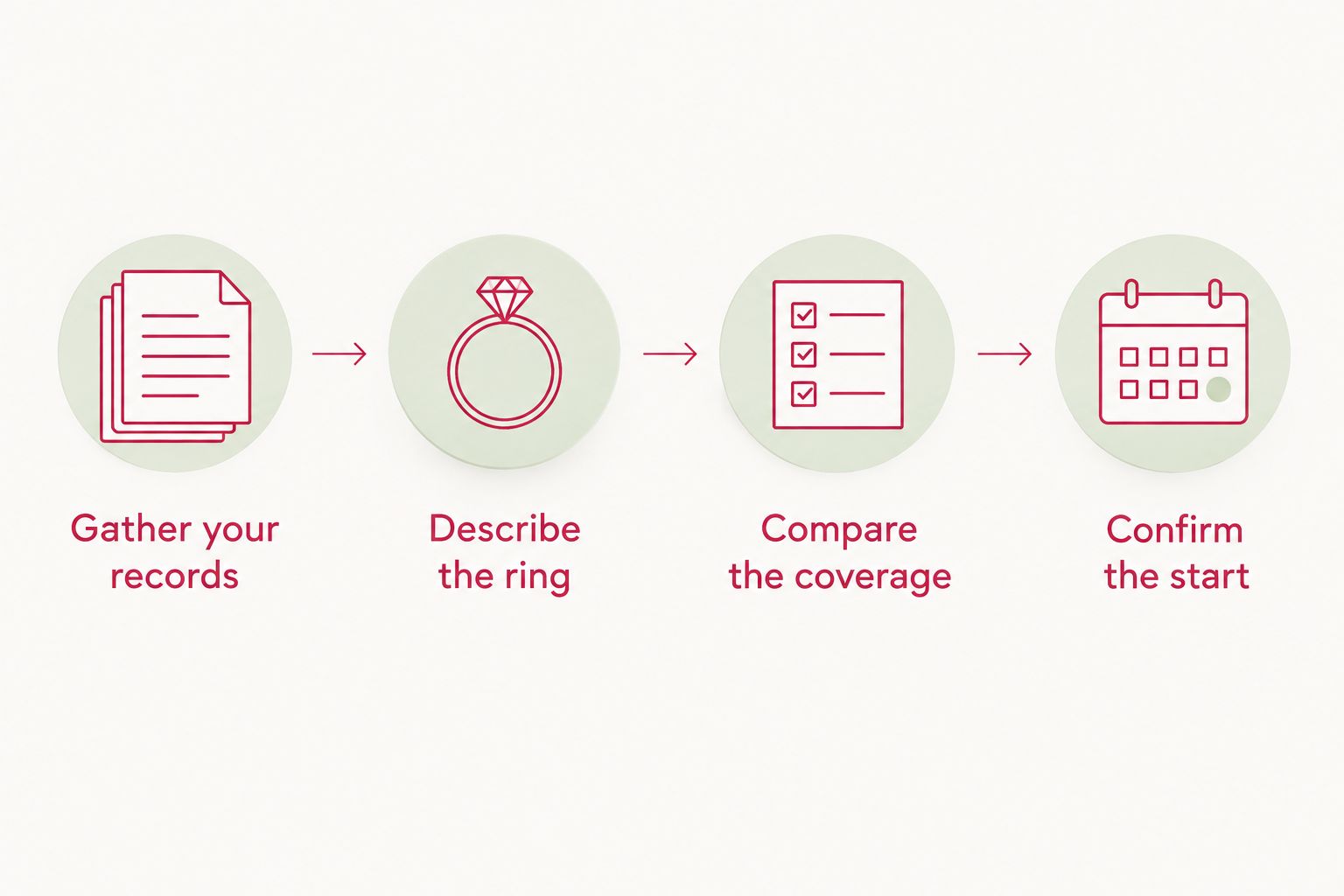
    Four steps for insuring a ring, from collecting records to confirming the coverage start date.
    Confirm the effective date before treating the ring as insured.

    Why lab-grown diamond ring insurance varies

    Insurance is a contract for a particular item and set of risks. Two people buying similar-looking engagement rings can receive different terms because their applications and coverage choices differ.

    For a 2026 comparison, check these factors directly with each insurer:

    • Insured value: The insurer needs an accepted value for the complete ring. Ask which documents establish that value and how updates work.
    • Location: Your residence and where you keep the ring are application details. Give accurate information rather than using someone else's quote as your benchmark.
    • Deductible: This is the portion of a covered claim you bear under the policy. Compare the deductible as well as the coverage itself.
    • Covered losses: Theft, accidental loss, and accidental damage are separate questions. Ask about each instead of accepting a general statement that the ring is protected.
    • Settlement terms: Repair, replacement, reimbursement, and cash settlement are not the same outcome. Find out which options the contract provides.
    • Use and travel: Confirm territorial coverage and any conditions affecting travel, storage, or work performed on the ring.

    Choose the policy with acceptable claim terms, not simply the broadest-sounding description. Ask for written clarification when a quote summary leaves an important question unanswered.

    What losses should you ask the insurer about?

    Use realistic situations to test the wording. An insurer's answer to a specific scenario is more useful than a general assurance about protection.

    Theft and unexplained disappearance

    Ask how the policy handles a stolen ring and a ring you cannot locate. These are different circumstances, and coverage for theft does not establish coverage for unexplained disappearance.

    Also ask what evidence a claim requires. Keep purchase records and photographs somewhere you can access even if your belongings are stolen.

    Damage and missing stones

    Ask about a chipped diamond, a bent setting, and a center stone that falls out. Then ask whether the cause of damage changes the answer.

    Do not confuse insurance with maintenance. Policies distinguish covered events from exclusions such as wear, deterioration, or manufacturing defects; read the wording that applies to your ring.

    Travel and work on the ring

    Check whether protection applies outside the US and whether travel creates special conditions. Confirm separately what happens while a jeweler holds the ring for inspection, resizing, or repair.

    If you later change the setting or add stones, notify the insurer. The insured description should match the ring you actually own, not the earlier version in your purchase folder.

    Does a lab-grown diamond ring need an appraisal for insurance?

    A lab-grown diamond ring needs an appraisal when the insurer requires one. Some applications accept other purchase documentation, so ask before paying for an appraisal solely to obtain coverage.

    A grading report and an appraisal are not interchangeable. The grading report describes the diamond; the appraisal assigns a value to the described item for its stated purpose.

    Ask whether the appraisal must include the mounted ring, photographs, measurements, laboratory-grown disclosure, and the setting's details. Also ask how recent the document must be and whether the insurer has appraiser requirements.

    For a custom oval or pear engagement ring, make sure the description identifies the actual shape and finished setting. A generic description creates avoidable questions when a replacement needs to match the original.

    Will insurance replace a lab-grown diamond with a natural diamond?

    Do not assume insurance will replace a lab-grown diamond with a natural diamond. Claim settlement follows the policy and the insured description; laboratory-grown origin belongs in that description.

    Ask how the insurer determines a comparable replacement. Shape, carat weight, color, clarity, dimensions, metal, and setting details all help describe what you own, but the contract determines the settlement process.

    If the original ring has sentimental design details, discuss them before buying coverage. A replacement with similar diamond specifications is not necessarily a match for a distinctive setting.

    How much should you insure a lab-grown diamond ring for?

    Insure the ring using a value the insurer accepts for the complete item and its settlement basis. Do not select a larger amount solely because it appears to promise a larger payout.

    An insured limit is not automatically a guaranteed cash payment. Ask whether a claim uses replacement cost, an agreed value, actual cash value, or another basis defined in the contract.

    For a 2026 application, use current documentation requested by the insurer. Ask when to review the value again and what happens if the amount needed to replace the ring changes.

    Keep your shopping budget separate from this decision. Your budget determines what you buy; the insurance contract determines how an accepted claim is settled.

    Your before-checkout insurance checklist

    Before completing an online ring purchase, decide which questions need answers from the seller and which belong with the insurer. The seller documents what you are buying; the insurer confirms what it will protect.

    Use 1 written ring description consistently across your purchase records, appraisal, and insurance schedule. Resolve discrepancies rather than assuming a claims handler will interpret them in your favor.

    • Confirm that every document identifies the diamond as laboratory-grown.
    • Check that the insured item includes the setting and any accent stones.
    • Match the shape, metal, and stone details to the finished order.
    • Ask whether photographs or a grading report are required.
    • Read the deductible and the relevant exclusions.
    • Confirm when coverage begins and how to report a loss.
    • Save the issued policy, not just the quote or application.

    For an Ava Lee Diamonds lab-grown diamond engagement ring, keep the purchase documentation with the final design specifications. Arrange coverage based on those records, and ask the insurer to resolve any documentation gaps before you rely on the policy.

    FAQ

    Can I insure a lab-grown diamond engagement ring bought online?

    Yes, an online purchase can be insured if the insurer accepts the ring and your application. Keep the itemized receipt, final specifications, photographs, and any grading report, and confirm when coverage begins.

    Does homeowners insurance automatically cover my lab-grown diamond ring?

    Do not assume homeowners insurance fully covers your lab-grown diamond ring. Check jewelry limits, covered causes of loss, and whether you need to list the ring separately through scheduled coverage.

    Is specialist jewelry insurance better than adding the ring to renters insurance?

    The better choice is the policy with covered losses, deductibles, and settlement terms that fit your needs. Compare the actual contracts rather than choosing solely by policy type.

    Can I insure a ring without a diamond grading report?

    Ask the insurer whether it accepts the ring without a grading report. Documentation requirements differ, and a receipt or appraisal serves a different purpose from a diamond grading report.

    Will ring insurance pay if I lose the center diamond?

    Payment for a lost center diamond depends on whether the policy covers the circumstances of the loss. Ask specifically about a stone falling from its setting and review the relevant exclusions.

    Does a jewelry warranty replace insurance?

    A jewelry warranty does not replace insurance. A warranty addresses its stated product or service obligations, while insurance covers losses defined in the policy; read both documents separately.

    Do I need to update insurance after changing my ring setting?

    Notify the insurer after changing your ring setting or other insured details. Ask whether the revised ring needs updated photographs, an appraisal, or a change to the insured value.

    Should my lab-grown diamond ring appraisal be higher than its purchase amount?

    Do not request an inflated appraisal to obtain a larger insurance limit. Use an accurate valuation appropriate to the insurer's requirements, and confirm how the policy settles a covered claim.

    One last thing

    Ask about replacement before you ask about the insured limit. A large figure on a schedule tells you less than a clear explanation of who selects the replacement, what must match, and whether you have a cash-settlement option.

    Before wearing your new ring in 2026, save the issued policy and the insurer's written answers. That is the practical finish line: an accurately described ring with confirmed coverage, not an unfinished application.

    Related guides

    Continue reading
  • Do lab-grown diamonds hold their value?

    Do lab-grown diamonds hold their value?

    Lab-grown diamonds do not reliably hold their purchase value, so buy one for the ring you want to wear—not as an investment. In 2026, the practical distinction is between enjoying your diamond and finding a buyer willing to pay for it later. An appraisal, grading report, or replacement-value figure does not guarantee a cash resale offer.

    TL;DR
    • Do lab-grown diamonds hold their value? Not reliably; buy for wear, not expected resale profit.
    • Ava Lee Diamonds lab-grown engagement rings suit couples choosing a ring to wear rather than an investment.
    • An insurance appraisal estimates replacement value, not the cash a buyer will offer.
    • Compare lab-grown and natural diamonds by purchase priorities; neither comes with guaranteed investment returns.

    Do lab-grown diamonds hold their value?

    Lab-grown diamonds are not a dependable store of purchase value. Their resale value depends on an actual buyer's offer, not the original receipt or the amount shown on an insurance appraisal. You should not build your engagement-ring budget around recovering what you spend.

    The comparison below separates the main ways people use the word value. Each answers a different question, and none should substitute for a written cash offer when you need to sell.

    Type of value What it tells you Useful for Limitation
    Retail purchase amount What you paid for the finished jewelry Tracking your spending Does not establish a future selling amount
    Insurance replacement value An estimate used to describe replacement exposure Discussing coverage with an insurer Is not a cash offer
    Cash resale offer What a specific buyer will pay under stated terms Deciding whether to sell Applies to that buyer and transaction
    Metal recovery value The recoverable precious-metal component Understanding one part of a jewelry offer Does not value the complete ring as wearable jewelry
    Personal value What wearing and keeping the ring means to you Choosing something you want to own Cannot be converted into a guaranteed resale amount

    Before shopping, use a budget for a custom lab-grown engagement ring to set a spending limit that works without a future sale. That keeps your decision focused on what you can comfortably own.

    Why this matters

    Your engagement ring has a job before it has a resale question: it needs to suit your taste, daily routine, and shared budget. Treating it as an investment adds an expectation the purchase cannot promise to meet.

    For your 2026 purchase, separate two decisions: how much you want to spend and whether you need that money to remain accessible. Money reserved for emergencies should not depend on finding a jewelry buyer.

    This does not make a lab-grown diamond a bad purchase. It makes the reason for buying important. A ring can be a satisfying purchase without being a reliable financial asset.

    Lab-grown versus natural diamonds: which fits your goal?

    Natural diamonds also typically resell for less than their original retail purchase price. Losing value relative to what you paid is not unique to lab-grown diamonds. Choose between lab-grown and natural diamonds by the ownership experience you want, not an expectation of getting your money back.

    Both require careful evaluation of the individual stone. Origin is one characteristic; proportions, condition, documentation, and the finished setting still matter.

    Option Best for Main benefit Main trade-off
    Lab-grown diamond Couples who want a diamond without prioritizing natural origin Lets you choose diamond jewelry without paying for natural geological origin Future resale proceeds are uncertain; do not assume recovery of your spending
    Natural diamond Buyers who specifically value natural geological origin Provides the origin characteristic those buyers want Natural origin alone does not guarantee resale profit or recovery of retail spending
    Keeping your current ring Owners who still enjoy its appearance and fit Avoids making another purchase solely to pursue resale value Does not turn the existing ring into accessible cash

    If natural origin matters deeply to you, include it in your decision. If it does not, avoid paying for that characteristic solely because someone describes natural diamonds as investments.

    The useful question is not which category always wins. It is which ring meets your priorities without requiring an optimistic prediction about selling it.

    Why lab-grown diamond resale value varies

    A resale offer reflects the item and the buyer's business model. These factors explain why a receipt alone cannot tell you what you will receive:

    • Buyer acceptance: Establish whether the buyer purchases lab-grown diamonds before sending jewelry or arranging an appointment.
    • Stone characteristics: Shape, carat weight, color, clarity, and visible appearance describe the diamond being evaluated.
    • Condition: Damage, wear, and required repair work affect how a buyer assesses the finished piece.
    • Documentation: A grading report helps identify the stone's reported characteristics; it does not set a resale amount.
    • Setting and metal: The mount is a separate component, with its own material, condition, and potential reuse.
    • Transaction terms: Fees, shipping, inspection conditions, and payment terms determine what you actually receive.

    Do not convert this list into an estimated resale percentage. The same ring can receive different treatment from different buyers, and a buyer who declines the stone has not established its value everywhere else.

    Get offers for your actual ring rather than applying an online percentage to your receipt. That is the evidence relevant to your decision.

    How do you check what your ring is worth?

    For a 2026 resale decision, collect written terms before deciding whether an offer works for you. Keep a cash sale separate from store credit, an exchange, or an insurance settlement.

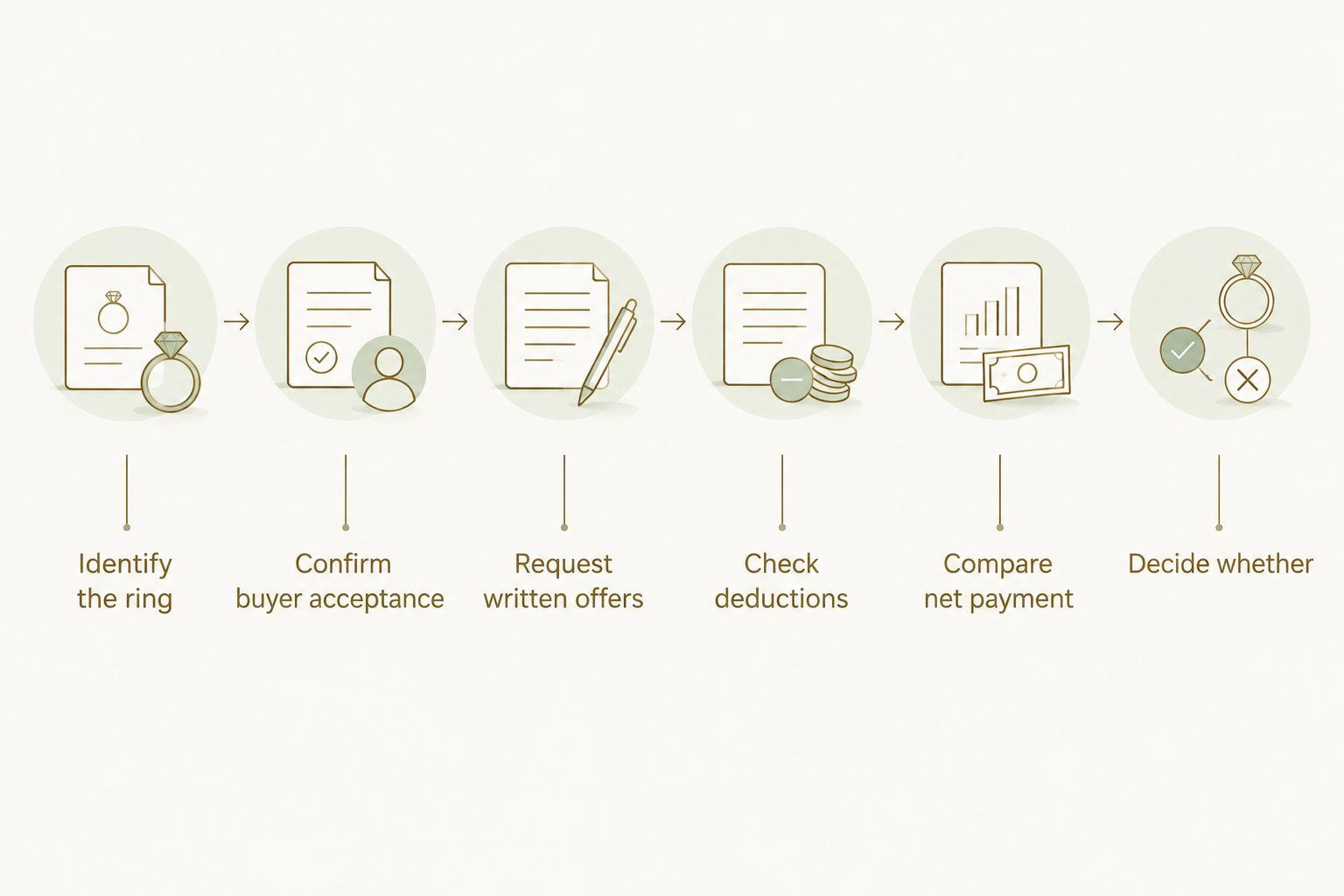
    1. Identify the ring. Gather the receipt, any grading report, metal description, and clear photographs. Separate confirmed information from assumptions.
    2. Confirm buyer acceptance. Ask whether the business buys lab-grown diamonds and whether it evaluates the stone, setting, or complete ring.
    3. Request written offers. Ask what remains conditional on inspection and when the offer expires.
    4. Check deductions. Establish who pays shipping, insurance, inspection, and return costs if you decline.
    5. Compare net payment. Compare what you receive after deductions, using the same transaction type.
    6. Decide whether to sell. Weigh the net payment against keeping, repairing, or redesigning jewelry you still want.
    Steps for checking a lab-grown diamond ring's resale offer
    Compare net cash payment, not an appraisal or an offer before deductions.

    A large headline offer is not enough if the terms are unclear. Ask how your jewelry will be returned if you reject the final offer, and keep copies of the agreement and shipping documentation.

    Does an appraisal tell you what you can sell it for?

    An insurance appraisal is not a promise of resale proceeds. Read its stated purpose before using the figure to make a selling decision. A replacement estimate and a buyer's acquisition offer answer different questions.

    A grading report has another role. It records characteristics of the diamond, rather than guaranteeing what a future purchaser will pay. Check that the report relates to your stone and describes its laboratory-grown origin correctly.

    For a purchase in 2026, ask what documentation accompanies the specific ring before checkout. Do not assume every item includes the same report, appraisal, or supporting paperwork.

    Keep these documents together. They help you describe the ring accurately even though they do not guarantee a sale.

    Does the gold setting hold value separately?

    A precious-metal setting has a material component separate from its diamond. That does not mean a buyer will repay the amount originally charged for the finished setting, which also reflects design and manufacturing work.

    Gold purity helps you understand the material description. 14K gold contains 14 parts gold out of 24; 18K gold contains 18 parts out of 24. Neither marking states the ring's total weight or the amount a buyer will pay.

    Diamond weight uses a different system: 1 carat equals 200 milligrams. Carat weight measures mass, not cash value, and total carat weight can describe multiple stones together rather than one center diamond.

    These distinctions matter when comparing jewelry offers. Ask whether an offer covers the complete ring or only recoverable metal; those are not equivalent valuations.

    Should you buy a lab-grown ring if resale matters to you?

    Buy a lab-grown ring only if you are comfortable judging it mainly by ownership, not expected resale. If recovering your spending is essential, pause the purchase rather than assuming a different diamond category solves that problem.

    Ava Lee Diamonds lab-grown engagement rings suit couples choosing a ring to wear rather than an investment. The practical benefit of customization is choosing the combination you want; it is not a promise that every design choice will be recovered at resale.

    There are trade-offs. Personalizing a ring helps it fit your preferences, but your preferences do not establish what another buyer wants. Keep the design because you like it, not because you expect a future purchaser to reimburse each feature.

    For an oval or pear engagement ring, put your attention on the individual diamond's appearance, the security of the setting, and how the ring works with a wedding band. Extra carat weight is not a substitute for checking those details.

    A buying checklist for couples

    Before ordering, agree on these points:

    • Spending limit: Choose an amount you can spend without depending on resale.
    • Shape preference: Decide whether you actually want oval, pear, round, or another outline.
    • Visual evidence: Review the specific diamond's photographs or video rather than judging only by a specification list.
    • Setting fit: Consider how the ring sits on your hand and beside a wedding band.
    • Written policies: Read the current return, resizing, repair, and warranty terms for the item.
    • Documentation: Confirm which reports or records accompany the purchase.

    For your 2026 shortlist, compare complete rings rather than isolated carat weights. A stone, setting, and policy package must work together for your purchase to make sense.

    Can you trade in a lab-grown diamond instead of selling it?

    A trade-in is not the same as a cash sale. Its usefulness depends on the written program terms and whether you genuinely want the replacement jewelry.

    Check whether the specific lab-grown item qualifies, what further purchase is required, and whether the allowance is cash or store credit. Do not assume a retailer offers a program because another jewelry business does.

    When considering Ava Lee Diamonds, verify the current terms relevant to your purchase rather than assuming a future trade-in. Treat any unconfirmed future benefit as outside your buying decision.

    Should you insure a lab-grown engagement ring?

    Resale value and insurance serve different purposes. Insurance addresses covered loss or damage under a policy; a resale offer addresses what a buyer will pay for jewelry you own.

    Ask the insurer how replacement works, what documentation is required, and which exclusions apply. Read the deductible and settlement terms rather than assuming the appraisal amount becomes a cash payment.

    Keep records current when you change the setting or replace a stone. The goal is an accurate description of what you own, not an inflated figure that makes the ring appear to be an investment.

    FAQ

    Do lab-grown diamonds hold their value in 2026?

    Lab-grown diamonds do not reliably hold their purchase value in 2026. Buy for wearing and personal enjoyment rather than assuming you will recover your spending through resale.

    Can I sell a lab-grown diamond engagement ring?

    You can seek offers from buyers who accept lab-grown diamond engagement rings. Confirm acceptance and written transaction terms before sending your jewelry.

    Are natural diamonds a better investment than lab-grown diamonds?

    Natural diamonds do not come with guaranteed investment returns. Choose natural origin because you value that characteristic, not because you assume every natural diamond appreciates.

    Does my insurance appraisal show my ring's resale value?

    An insurance appraisal does not establish your ring's cash resale value. Read its stated purpose and obtain actual buyer offers when deciding whether to sell.

    Does a grading report guarantee what my diamond is worth?

    A grading report does not guarantee a diamond's resale value. It records characteristics that help identify and evaluate the stone.

    Is a bigger lab-grown diamond better for resale?

    A bigger lab-grown diamond does not guarantee a better resale outcome. Carat weight is one characteristic, and buyer acceptance, condition, and transaction terms still matter.

    Should I choose Ava Lee Diamonds if I want a ring to keep?

    Ava Lee Diamonds offers lab-grown engagement rings and customizable ring-building options for buyers choosing jewelry to wear. Compare the specific ring's details and current policies; do not base the purchase on expected resale proceeds.

    One last thing

    Before placing an order, ask yourself: would you still choose this ring if you kept it indefinitely and never sold it? That question removes an uncertain resale assumption from a very personal decision.

    For a 2026 engagement-ring purchase, choose the ring you can comfortably keep. If the answer depends on getting your money back later, reduce the budget or wait.

    Related guides

    Continue reading