Guides

  • Best lab-grown diamond pendants in 2026

    Best lab-grown diamond pendants in 2026

    Best overall: a round solitaire. Best for a smooth setting: a bezel-set solitaire. Best for an elongated outline: an oval pendant. Best for a pointed silhouette: a pear pendant. Best for a decorative frame: a halo pendant. This 2026 guide ranks lab grown diamond pendant styles by how they look, wear, and fit your buying priorities—not by unverified product claims.

    TL;DR
    • A round solitaire is the best lab grown diamond pendant starting point when you want a simple, versatile design.
    • Choose a bezel-set solitaire for a metal rim around the diamond; choose prongs for a more exposed outline.
    • Oval and pear pendants suit shoppers who prefer elongated shapes, but inspect their appearance in motion.
    • Ava Lee Diamonds shoppers should confirm diamond origin, pendant dimensions, and chain details before ordering.

    Why this matters

    A pendant purchase involves more than choosing a diamond. The setting controls its outline, the bail connects it to the chain, and the chain determines where the finished piece rests. A diamond you like in a close-up photograph still needs a wearable necklace around it.

    Ava Lee Diamonds sells lab-grown diamond fine jewelry. For Ava Lee Diamonds shoppers, the best lab grown diamond pendant is one with a secure setting, a suitable chain, and clearly stated stone details. Use those requirements to narrow your 2026 shortlist before comparing carat weights.

    Lab-grown diamonds are diamonds, not diamond simulants such as cubic zirconia. Their origin does not tell you whether a particular stone has attractive proportions, whether its setting suits you, or whether the listing includes a chain. Check those separately.

    What makes the best lab-grown diamond pendant?

    Rank your choices against these criteria before you fall for a photograph:

    • Setting security: Look for clear views of the prongs or bezel and ask how the stone is held.
    • Visible appearance: Compare the diamond's face-up dimensions and appearance, not weight alone.
    • Chain compatibility: Confirm the bail opening, chain thickness, clasp, and whether the chain is included.
    • Wearability: Inspect the back, edges, and overall profile where the pendant touches your skin or clothing.
    • Specification clarity: Separate the center-stone weight from combined diamond weight, and verify lab-grown origin.
    • Budget control: Compare complete necklaces with equivalent specifications rather than pendant-only listings against finished pieces.

    No single style wins every category. A bezel adds a visible metal border, while prongs leave more of the diamond's edge exposed. A halo adds surrounding stones but also adds details you need to inspect and maintain.

    Best lab-grown diamond pendant styles at a glance

    These are design recommendations, not rankings of specific store products. The order follows the needs of a first-time buyer: start simple, then choose a more specialized outline or setting.

    Pendant style Best for Standout feature Key limitation
    Round solitaire An undecided first-time buyer A circular center stone without surrounding diamonds Prongs leave parts of the stone's edge exposed
    Bezel-set solitaire A smooth setting outline A metal rim around the diamond The rim changes how much diamond edge you see
    Oval pendant An elongated, rounded shape Length without a pointed tip Dark bow-tie contrast needs visual inspection
    Pear pendant A directional silhouette One rounded end and one point The pointed tip needs appropriate protection
    Halo pendant A decorative diamond frame Smaller diamonds surrounding a center stone Total weight can obscure the center-stone size

    1. Round solitaire: best pendant for a first purchase

    A round solitaire pendant places one round diamond at the center of the design. In this comparison, the default is a prong-set version without a halo or additional decorative stones. It gives you a straightforward way to compare diamond appearance, metal, and chain details.

    Best for: You want a pendant that keeps the diamond itself as the main feature.

    For a first purchase in 2026, this is the clearest starting point. You can decide whether you like the diamond before adding questions about surrounding stones or a more elaborate outline.

    Round solitaire pros:

    • Makes the center diamond the visual focus.
    • Keeps the design simple when comparing listings.
    • Offers a circular outline without choosing an orientation.

    Round solitaire cons:

    • Exposed prongs require attention during wear and inspection.
    • A simple setting does not guarantee attractive diamond appearance.
    • The pendant still needs a compatible chain and bail.

    Inspect the pendant from the side as well as the front. A deep basket or projecting bail changes how the necklace rests, even when the front photograph looks minimal.

    Verdict: Buy a round solitaire if you want the simplest default.

    2. Bezel-set solitaire: best pendant for a smooth outline

    A bezel-set solitaire holds the diamond within a metal rim rather than relying only on separate prongs. The rim becomes part of the pendant's appearance. Choose it because you like that framed look, not because every bezel is automatically identical in comfort or construction.

    Best for: You prefer a continuous metal border around the stone.

    A full bezel covers the diamond's perimeter. A partial bezel leaves sections open, so inspect the actual design rather than treating every listing with the word bezel as equivalent.

    Bezel-set solitaire pros:

    • Places metal around the diamond's edge.
    • Creates a clearly defined outline.
    • Avoids separate exposed prong tips around a full bezel.

    Bezel-set solitaire cons:

    • The metal rim changes the visible outline of the diamond.
    • An enclosed setting can make some areas harder to reach for cleaning.
    • A bulky rim will not suit someone seeking a barely visible setting.

    Compare front and back photographs. Look for a finished back and ask how to clean the stone safely; the setting's construction matters more than the style name alone.

    Verdict: Buy a bezel-set solitaire if the metal frame is part of what you love.

    3. Oval pendant: best pendant for an elongated rounded shape

    An oval pendant gives you a longer outline with rounded ends. The shape can hang vertically or sit horizontally, depending on the design. Check the orientation before ordering because it changes the necklace's appearance.

    Best for: You like an elongated diamond but do not want a pointed end.

    Oval diamonds can show a bow-tie pattern: a darker area across the center caused by how the facets handle light. View the actual stone in motion rather than judging it from a single bright photograph.

    Oval pendant pros:

    • Offers an elongated alternative to a round diamond.
    • Has rounded ends rather than exposed points.
    • Gives you a choice of orientation when the design supports it.

    Oval pendant cons:

    • Bow-tie contrast requires visual inspection.
    • Equal carat weights do not guarantee equal outlines.
    • Orientation and bail placement affect the finished look.

    For your 2026 comparison, record each oval's length and width in millimeters. Compare those measurements alongside video; neither dimensions nor grading information replaces looking at the stone.

    Verdict: Buy an oval pendant if you prefer length and rounded ends.

    4. Pear pendant: best pendant for a pointed silhouette

    A pear pendant combines a rounded end with a tapered point. Its direction gives the design a stronger sense of orientation than a round solitaire. Confirm which way the point faces and how the pendant attaches to its chain.

    Best for: You want the diamond's outline to be a defining design feature.

    The point deserves close attention. Ask how the setting protects it, and inspect whether the rounded shoulders look balanced on either side of the stone's centerline.

    Pear pendant pros:

    • Creates a recognizable teardrop outline.
    • Combines a curved edge with a distinct point.
    • Makes orientation part of your design choice.

    Pear pendant cons:

    • The pointed tip needs appropriate setting protection.
    • Bow-tie contrast can affect the center's appearance.
    • Uneven shoulders can change the shape's visual balance.

    Do not select a pear solely because it weighs more than another option. A shape you enjoy looking at is more useful than extra weight in proportions you dislike.

    Verdict: Buy a pear pendant if you love the outline and approve its tip protection.

    5. Halo pendant: best pendant for a decorative frame

    A halo pendant surrounds its center stone with smaller diamonds. It adds a diamond-set border rather than leaving the center stone alone. Confirm whether every diamond is lab-grown if that origin matters to your purchase.

    Best for: You prefer a detailed frame over the simplicity of a solitaire.

    Read the weight description carefully. Combined diamond weight includes multiple stones; it does not tell you the weight or dimensions of the center diamond by itself.

    Halo pendant pros:

    • Adds a surrounding diamond outline.
    • Gives you a more decorative alternative to a solitaire.
    • Makes the relationship between center and border part of the design.

    Halo pendant cons:

    • More stone settings mean more details to inspect.
    • Small spaces around the halo need cleaning attention.
    • A prominent border can compete with the center diamond.

    Ask for the center-stone specifications separately from the surrounding diamonds. That keeps your 2026 comparison focused on what you are actually choosing.

    Verdict: Buy a halo pendant if you want the frame, not just a larger weight figure.

    How we ranked the pendant styles

    The ranking prioritizes specification clarity, setting construction, chain compatibility, visible appearance, wearability, and budget control. A round solitaire leads because its design is the simplest starting point for comparing those elements. The other styles each serve a distinct preference rather than representing lower quality.

    This is not a wear-test ranking or a claim that one seller outperforms another. Assess each finished pendant against the same criteria before you order.

    Check the diamond, metal, and chain before buying

    Separate weight from visible size

    Carat measures mass: 1 carat equals 200 milligrams. It does not specify a diamond's diameter, length, or width. Two stones with equal weights can have different face-up dimensions because their proportions differ.

    Keep carat weight and metal karat separate, too. 14K gold contains 14 parts gold out of 24; 18K gold contains 18 parts out of 24. Those markings describe gold content, not diamond quality or the strength of a particular clasp.

    Compare complete necklaces

    A pendant is the decorative piece; a necklace also needs a chain. Confirm whether the listing includes both, then check chain length, thickness, clasp type, and the pendant's attachment.

    An 18-inch chain describes length, not a guaranteed position on every wearer. Your neck, neckline, and pendant size affect where it rests. Use a necklace you already own as a physical reference rather than relying only on a model photograph.
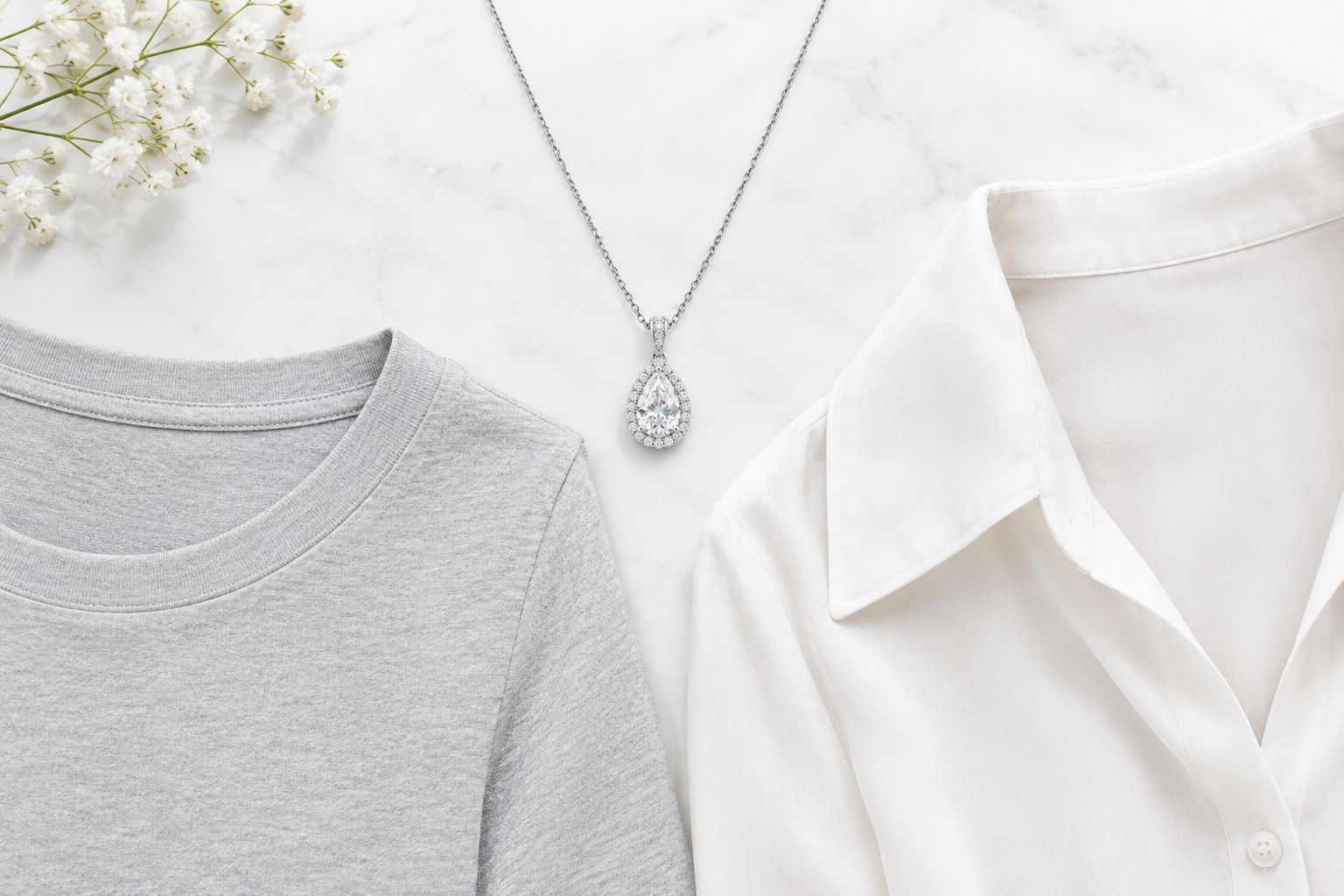
    A solitaire pendant necklace beside two different clothing necklines
    Use your own necklines and an existing necklace to judge the length you want.

    Keep your budget comparison consistent

    Compare the same diamond origin, similar dimensions, the same metal specification, and equivalent chain inclusions. A more elaborate setting is not automatically a better use of your budget. Decide which visible feature you would miss before paying for additional detail.

    For a 2026 order, save the final specifications and read the current purchase terms before checkout. Verify any return, resizing, repair, or warranty provision directly rather than assuming jewelry sellers use identical policies.

    Which lab-grown diamond pendant should you choose?

    Choose a round solitaire if you are undecided. Move to a bezel for the metal border, an oval for rounded length, a pear for its point, or a halo for surrounding detail.

    Keep your final shortlist small enough to compare each actual stone and finished necklace carefully. Ava Lee Diamonds buyers should confirm the lab grown diamond pendant specifications at the individual item level, including the chain and any accent stones.

    FAQ

    What's the best lab grown diamond pendant for a first purchase?

    A round solitaire is the best starting point if you want a simple design centered on one diamond. Confirm the setting, stone dimensions, and chain details before choosing the finished necklace.

    Is a lab-grown diamond pendant a real diamond pendant?

    Yes, a lab-grown diamond pendant contains diamond grown through a technological process rather than formed underground. Lab-grown diamond is not the same material as cubic zirconia or other diamond simulants.

    Is a bezel pendant better than a prong-set pendant?

    A bezel pendant is better if you prefer a continuous metal rim around the diamond. A prong-set pendant suits you better if you prefer more of the stone's edge exposed; inspect construction in either case.

    Should I choose an oval or pear diamond pendant?

    Choose an oval for an elongated shape with rounded ends, or a pear for a rounded end and a distinct point. Inspect both in motion for dark bow-tie contrast, and check the pear's tip protection.

    Does a diamond pendant always come with a chain?

    No, the word pendant does not establish that a chain is included. Confirm the listing's contents, chain specifications, and compatibility with the pendant before ordering.

    Does total carat weight tell me the center diamond's size?

    No, total carat weight combines the weight of the diamonds described by that listing. Ask for the center stone's individual weight and millimeter dimensions, especially when comparing halo designs.

    What should I check before buying a pendant online?

    Check diamond origin, actual-stone images, dimensions, metal, setting, chain inclusions, and current purchase terms. Ask for clarification before checkout whenever the description leaves an essential detail unclear.

    One last thing

    Inspect the back before approving the front. The back shows the part that rests against you, while side views reveal depth and attachment details that a face-on photograph hides. Ask for those views before committing to a pendant you have only seen from one angle.

    Related guides

    Continue reading
  • Can you tell a lab-grown diamond apart from a natural one?

    Illustrative side-by-side comparison of two matching yellow-gold engagement rings with diamond-set bands and four-claw center settings

    You cannot reliably tell a lab-grown diamond apart from a natural diamond with your eyes, a phone camera, or an ordinary jeweler’s loupe. Both are real diamonds; identifying their origin requires suitable screening equipment or laboratory testing, so appearance alone is not proof.

    TL;DR
    • Can you tell a lab-grown diamond apart from a natural diamond? Not reliably by appearance alone.
    • Ava Lee Diamonds sells lab-grown diamond engagement rings; choose appearance separately from verifying diamond origin.
    • A basic diamond tester does not establish natural origin; specialized screening and laboratory testing serve different purposes.
    • For oval and pear engagement rings, assess sparkle, shape, and setting after checking the diamond’s documentation.

    Can you tell a lab-grown diamond apart from a natural diamond?

    Not reliably without specialized testing. Lab-grown and natural diamonds share the same essential chemical composition and crystal structure. Their origin differs, but that difference does not give every lab-grown diamond a visible feature that a shopper can recognize.

    This distinction matters when you compare engagement rings at Ava Lee Diamonds: deciding whether you like a diamond is a visual judgment, while verifying how it formed is an identification task.

    Check Lab-grown diamond Natural diamond What the check establishes
    Naked-eye appearance Can look colorless, bright, and clear Can look colorless, bright, and clear Personal preference, not origin
    Ordinary magnification Can reveal inclusions and surface features Can reveal inclusions and surface features Features that require expert interpretation
    Basic thermal diamond tester Can register as diamond Can register as diamond Material screening, not growth origin
    Specialized screening Can produce a result requiring further examination Can produce a result requiring further examination Whether additional identification is needed
    Laboratory examination Can identify laboratory growth characteristics Can identify natural growth characteristics Origin, using appropriate methods

    A photograph cannot replace the last row. Neither can a seller’s description of unusually strong sparkle or a claim that a stone looks too perfect to be natural.

    Why this matters

    For your 2026 engagement-ring purchase, separate three questions: Is this diamond lab-grown or natural? How well does it look and perform? Does the complete ring suit your daily life?

    Origin is not a beauty grade. A lab-grown diamond still needs careful selection, and a natural diamond does not automatically have better cut, clarity, or sparkle. Both categories contain stones with different visual strengths and weaknesses.

    Keeping those questions separate helps you direct your budget toward details you actually notice. It also prevents a common shopping mistake: treating an attractive video as proof of origin or treating laboratory origin as a guarantee of an attractive diamond.

    How do you verify a diamond’s origin before buying online?

    Use documentation to establish origin, then use photographs and video to judge appearance. Follow this sequence for a 2026 purchase rather than trying home tests after the ring arrives.

    1. Read the disclosure. Look for an explicit statement that the diamond is laboratory-grown or natural. Terms such as diamond, brilliant, and solitaire do not answer the origin question.
    2. Check the report. When a grading or identification report is supplied, read its identification language rather than stopping at the color and clarity grades.
    3. Match the details. Compare the report number, shape, measurements, and other identifying details with the diamond being offered. A report for a different stone proves nothing about your purchase.
    4. Check any inscription. If a report number or laboratory-grown inscription is present, have it compared with the paperwork. An inscription supports identification but is not a substitute for the full evidence.
    5. Resolve uncertainty. For an undocumented stone or a disputed description, request examination by a qualified gemological laboratory equipped for origin identification.

    Keep the listing, invoice, and report together. Those records help establish what was represented at sale; they do not eliminate the need to confirm that the paperwork belongs to the actual diamond.

    Naked-eye inspection: best for judging appearance

    Naked-eye inspection is best for deciding whether you enjoy a diamond’s brightness, outline, and overall look. Its limitation is straightforward: your eyes cannot reliably establish growth origin.

    Compare diamonds under similar lighting and at a similar viewing distance. Strong spotlights can make many stones flash dramatically, while a heavily edited close-up can hide the context you need to judge an engagement ring.

    For an oval or pear diamond, inspect how light and dark areas change as the stone moves. A persistent dark area deserves attention because of its appearance, not because it identifies the stone as laboratory-grown or natural.

    Magnification: best for examining details

    A loupe or microscope helps reveal inclusions, facet junctions, surface marks, and inscriptions. The advantage is a closer look; the limitation is that seeing a feature is not the same as correctly interpreting it.

    Some internal features provide trained gemologists with useful clues. However, an ordinary shopper cannot use a generic online inclusion chart to identify every diamond accurately, and some stones need more advanced examination.

    Do not buy a loupe expecting a universal lab-grown-diamond detector. Use magnification to support a documentation check or to understand a disclosed characteristic, not to replace laboratory identification.

    Specialized testing: best for establishing origin

    Specialized instruments examine properties that ordinary viewing does not reveal. Gemological laboratories use appropriate combinations of screening, spectroscopy, imaging, and expert interpretation to distinguish natural growth from laboratory growth.

    The benefit is an evidence-based identification. The limitation is that a screening result can require further testing: a referral result is not automatically a lab-grown result. Instrument capability and the stone being examined determine the next step.

    Ask a jeweler what the equipment actually establishes. A device described only as a diamond tester does not tell you whether it separates natural diamonds from laboratory-grown diamonds or simply screens diamond against other materials.

    Why visual identification varies

    Several factors explain why appearance is an unreliable shortcut. None gives you a universal at-home origin test.

    • Color: Both natural and laboratory-grown diamonds occur across different colors. A visible tint does not establish origin.
    • Clarity: Both categories can contain inclusions. A clean-looking stone is not proof of laboratory growth.
    • Cut: Facet arrangement and proportions affect light return. Strong sparkle does not prove natural origin.
    • Growth characteristics: Internal patterns and certain inclusions can provide evidence, but recognizing them requires suitable equipment and expertise.
    • Lighting: Reflections, exposure, and movement change what you see. A phone image records an appearance, not a laboratory identification.
    • Mounting: Prongs and metal can obscure parts of a diamond, including the girdle where an inscription might sit.

    For a 2026 online shortlist, reject origin claims based only on one of these visual factors. Ask for identification evidence instead, then return to the details that make the ring appealing to you.

    Does a lab-grown diamond sparkle differently?

    Lab-grown diamonds do not have a unique kind of sparkle that reliably distinguishes them from natural diamonds. Cut, proportions, cleanliness, lighting, and viewing conditions affect what you see in either category.

    If two stones look different, identify the actual difference before assigning it to origin. One might show stronger contrast, a different outline, or more visible inclusions; none of those observations alone answers how the diamond formed.

    Choose the diamond you prefer visually, then verify its disclosed origin independently. This avoids paying attention to the wrong comparison while overlooking a distracting feature in the exact stone you are buying.

    Can a jeweler tell if a diamond is lab-grown?

    A jeweler cannot reliably identify every lab-grown diamond just by looking at it. A jeweler with appropriate equipment can screen stones and arrange further laboratory examination when needed.

    Ask whether the assessment covers diamond origin specifically. Confirming that a stone is diamond is a different service from determining whether it grew naturally or in a laboratory.

    For an inherited ring or an undocumented secondhand purchase, start with identification rather than assumptions based on age, setting style, or family history. The diamond and its paperwork need to be evaluated together.

    Is a lab-grown diamond the same as cubic zirconia?

    A lab-grown diamond is not cubic zirconia. Laboratory-grown diamond is diamond, while cubic zirconia is a different material used to imitate diamond’s appearance.

    Moissanite is also a different material, not another name for laboratory-grown diamond. This is why a test intended to separate diamond from an imitation does not necessarily answer the natural-versus-laboratory-grown question.

    Read the material description carefully, especially when a listing uses broad phrases such as diamond alternative. You need the actual material and the diamond’s origin disclosed separately and clearly.

    What should you compare once origin is verified?

    Once you have checked origin, focus on the exact ring you will wear. Your 2026 checklist should cover the stone’s appearance, the setting’s construction, and the fit with a future wedding band.

    Shape and light return

    For oval and pear engagement rings, compare moving videos rather than choosing from a single flattering frame. Look at the outline, symmetry, and dark areas as the diamond tilts; assess the whole stone rather than one moment of bright sparkle.

    A pear’s point and an oval’s elongated outline also affect the ring’s overall shape on your hand. These are preference and design decisions, not evidence of diamond origin.

    Total weight and stone layout

    Read weight descriptions literally. Carat total weight, often abbreviated ctw, combines the diamonds included in the stated total; it does not automatically describe the weight of one center stone.

    For example, the supplied oval three-stone ring lists 1 1/5 ctw across three oval lab-grown diamonds. The supplied white-gold solitaire lists 3 1/2 ctw and a high-set elongated center stone; confirm the detailed center-stone specifications rather than inferring them from a title.

    Metal and setting

    The supplied examples use 14K gold, but their layouts differ substantially. A single high-set center and three stones arranged across the finger offer different looks and need separate fit assessments.

    Ask how the engagement ring sits beside your intended wedding band. Do not assume that a straight band will fit flush simply because both pieces look compatible from above.

    Ring configuration Best for Practical benefit Trade-off to assess
    White-gold claw-prong solitaire, 3 1/2 ctw A single-center look Places visual attention on the elongated center Its high setting needs a profile and band-fit check
    Yellow-gold oval three-stone rope-shank ring, 1 1/5 ctw Multiple oval stones Arranges three ovals across the top of the ring Total weight is distributed across the stones

    Ava Lee Diamonds is best for shoppers seeking lab-grown diamond engagement rings with customizable ring-building options. For the examples below, select the layout you prefer first, then verify the exact specifications and fit before ordering.

    Compare two lab-grown ring layouts
    3 1/2 ctw Lab-Grown Diamond Claw-Prong Solitaire Bezel-Style Engagement Ring or Band in 14K White Gold
    An elongated lab-grown center stone held high by four sculpted claws in 14K white gold.
    $3,510
    1 1/5 ctw Lab-Grown Diamond Oval Three-Stone Rope-Shank Ring in 14K Yellow Gold
    Three prong-set oval lab-grown diamonds totaling 1 1/5 ctw across the top of the ring.
    $1,855

    FAQ

    Can you tell a lab-grown diamond apart from a natural diamond in a photograph?

    You cannot reliably establish diamond origin from a photograph. Use images to judge appearance and suitable documentation or laboratory testing to verify origin.

    Will a lab-grown diamond pass a diamond tester?

    A lab-grown diamond can register as diamond on a basic thermal diamond tester because it is diamond. That result does not establish natural origin.

    Can you identify a lab-grown diamond with a loupe?

    A loupe alone cannot reliably identify every lab-grown diamond. It can help reveal an inscription or internal features, but those findings require correct interpretation and supporting evidence.

    Does a bow tie mean an oval diamond is lab-grown?

    A bow tie does not establish that an oval diamond is lab-grown. The dark pattern concerns the diamond’s appearance and light behavior, not a reliable origin distinction.

    Are lab-grown diamonds always flawless?

    Lab-grown diamonds are not always flawless. They can contain inclusions and other clarity characteristics, so inspect the exact stone and its report rather than assuming laboratory growth guarantees clarity.

    Is a diamond report enough to verify the ring I receive?

    A report is useful only when it belongs to the diamond you receive. Compare identifying details and any inscription, and obtain professional verification when the match is uncertain.

    What should I check before ordering from Ava Lee Diamonds?

    Before ordering from Ava Lee Diamonds, confirm the lab-grown diamond description, stated weight, metal, setting details, and any supplied report. Review the current purchase terms and ask about any unresolved specification before paying.

    One last thing

    A total-weight figure is not a face-up size measurement. Before completing your 2026 purchase, check the center stone’s measurements and the complete ring’s side profile, not just the carat figure in its name.

    That final check answers two practical questions origin testing cannot: whether you like the diamond’s proportions and whether the setting suits how you plan to wear it. Verify origin with evidence; choose the ring with your eyes and your daily routine in mind.

    Related guides

    Continue reading