Guides

  • Can you add a ring enhancer to any engagement ring?

    Can you add a ring enhancer to any engagement ring?

    No—you cannot add a wedding ring enhancer to every engagement ring without checking the fit. The enhancer must accommodate the center setting, band width, and ring profile without pressing against stones or prongs. This guide explains how to check compatibility, compare enhancer styles, and choose a pairing you can wear comfortably.

    TL;DR
    • A wedding ring enhancer must fit the engagement ring’s setting, not just match its finger size.
    • Ring guards frame both sides; curved wedding bands follow one side and need their own fit check.
    • Ava Lee Diamonds lab-grown diamond ring guards suit shoppers seeking diamond framing; confirm compatibility before ordering.
    • Check center-setting clearance, contact points, and combined width before choosing a ring enhancer.

    Why this matters

    An enhancer changes how your engagement ring looks and feels. You are choosing a combined ring set, not simply adding another band, so a flattering top view is only part of the decision.

    For your 2026 shopping shortlist, make compatibility the first filter and diamond detail the second. Before ordering, ask about the intended pairing through the ring-pairing contact page, with clear photos and the engagement ring’s measurements ready.

    A matching ring size does not prove that an enhancer fits your engagement ring. The opening around the setting and the space beneath the center stone matter just as much.

    Can you add a ring enhancer to any engagement ring?

    No. A ring enhancer works only when its shape and dimensions accommodate your engagement ring without forcing either piece out of position. A solitaire with room beneath its center setting presents a different fit problem from a low-set halo or a wide, detailed band.

    Start by choosing the type of pairing you want. These options create different looks and require different compatibility checks.

    Option Best for Main benefit Main limitation What to check
    Double-sided ring guard Framing the engagement ring above and below Adds a coordinated outline around the center ring The engagement ring must fit within the guard’s opening Opening width, setting clearance, and combined width
    Single curved wedding band Adding diamonds along one side Follows part of the engagement ring’s outline Its curve does not automatically match your setting Curve depth, contact points, and stone clearance
    Straight wedding band Keeping the pairing visually simple Avoids a shaped frame around the center stone A low setting can leave a gap between the bands Space beneath the setting and the preferred gap
    Custom-fitted enhancer Accommodating an unusual ring outline Allows a jeweler to plan around the existing ring Requires a design and fitting process The original ring’s construction and proposed contact points

    Choose the enhancer around the ring you own—not the other way around. If you are buying both pieces together in 2026, assess them as a set before committing to either design.

    Double-sided ring guards: best for framing both sides

    A double-sided ring guard places decorative elements on both sides of your engagement ring. The center ring sits within the opening, creating a more enclosed arrangement than a separate band worn beside it.

    The benefit is clear: you get diamond detail above and below the engagement ring. The trade-off is a more demanding fit because both sides must clear the setting and sit comfortably around the band.

    Look beyond the center opening in a product photo. Follow the engagement ring’s shoulders—the sections of band approaching the center stone—and check whether they would meet the guard before the ring reaches its intended position.

    Do not force a ring into a guard that looks almost right. Ask a jeweler to assess the combination if either piece needs pressure to sit in place.

    Curved wedding bands: best for a one-sided outline

    A curved band follows one edge of your engagement ring rather than enclosing it. This suits you if you want added diamond detail while keeping more of the original ring visible.

    Its advantage is a less enclosed arrangement. Its limitation is that the curve still needs to suit the center setting: a shallow curve and a deep curve create different amounts of space.

    For a pear-shaped center stone, compare the curve with both the rounded end and the pointed end of the setting. The guide to pairing a wedding band with a pear-shaped diamond ring focuses on that shape-specific decision.

    A curved band is not a universal-fit substitute for a ring guard. Check the actual pairing, even when both pieces look delicate.

    Why ring enhancer compatibility varies

    The engagement ring’s construction determines which enhancer shapes deserve a closer look. Use these factors to narrow your options before comparing decorative details.

    • Center-setting height: A raised center setting can leave space for an adjacent band; a low setting can occupy that space.
    • Setting footprint: A halo, basket, or projecting prong changes the outline the enhancer must accommodate.
    • Band width: The enhancer’s opening must accept the engagement ring’s band without forcing it into position.
    • Shoulder design: Split bands, side stones, and raised accents change where the rings meet.
    • Center-stone outline: Oval, pear, round, and elongated cushion settings require different surrounding space.
    • Combined width: A wider set changes how much of your finger the rings cover and how the combination feels.

    Metal color is a separate choice. A matching color creates visual continuity, but it does not establish mechanical compatibility; mixed colors do not automatically rule a pairing out.

    How do you check whether a ring enhancer fits?

    Check the engagement ring from above, from the side, and while worn with the proposed enhancer. Each view answers a different question, and none replaces a physical fitting when compatibility remains uncertain.

    Start with the engagement ring

    Record the ring size, band width, and any available setting measurements. Save a clear top view and side view so the jeweler can see the center basket, prongs, shoulders, and space beneath the stone.

    Use measurements rather than enlarging a product photograph on your screen. An image shows design, but it does not establish scale or clearance.

    Compare the opening

    For a double-sided guard, ask whether the opening accommodates the engagement ring along its full path into position. For a curved band, compare the curve with the part of the setting it will sit beside.

    A ring can appear to fit at the center while catching at the shoulders. Check both areas before treating the pairing as compatible.

    Inspect the contact

    Look for points where metal meets metal, metal meets a stone, or a prong meets another setting. Ask a jeweler to assess any contact involving stones or prongs rather than assuming close contact is desirable.

    A flush appearance is a style preference, not permission to press two settings together. Comfortable clearance matters more than eliminating every visible gap.

    Check the comfort

    Wear the proposed combination and bend your finger naturally. Check whether the set pinches, rotates uncomfortably, or feels too wide for your preference.

    Ask about sizing the combined set rather than automatically changing your usual ring size. The correct adjustment depends on the actual rings and your finger.
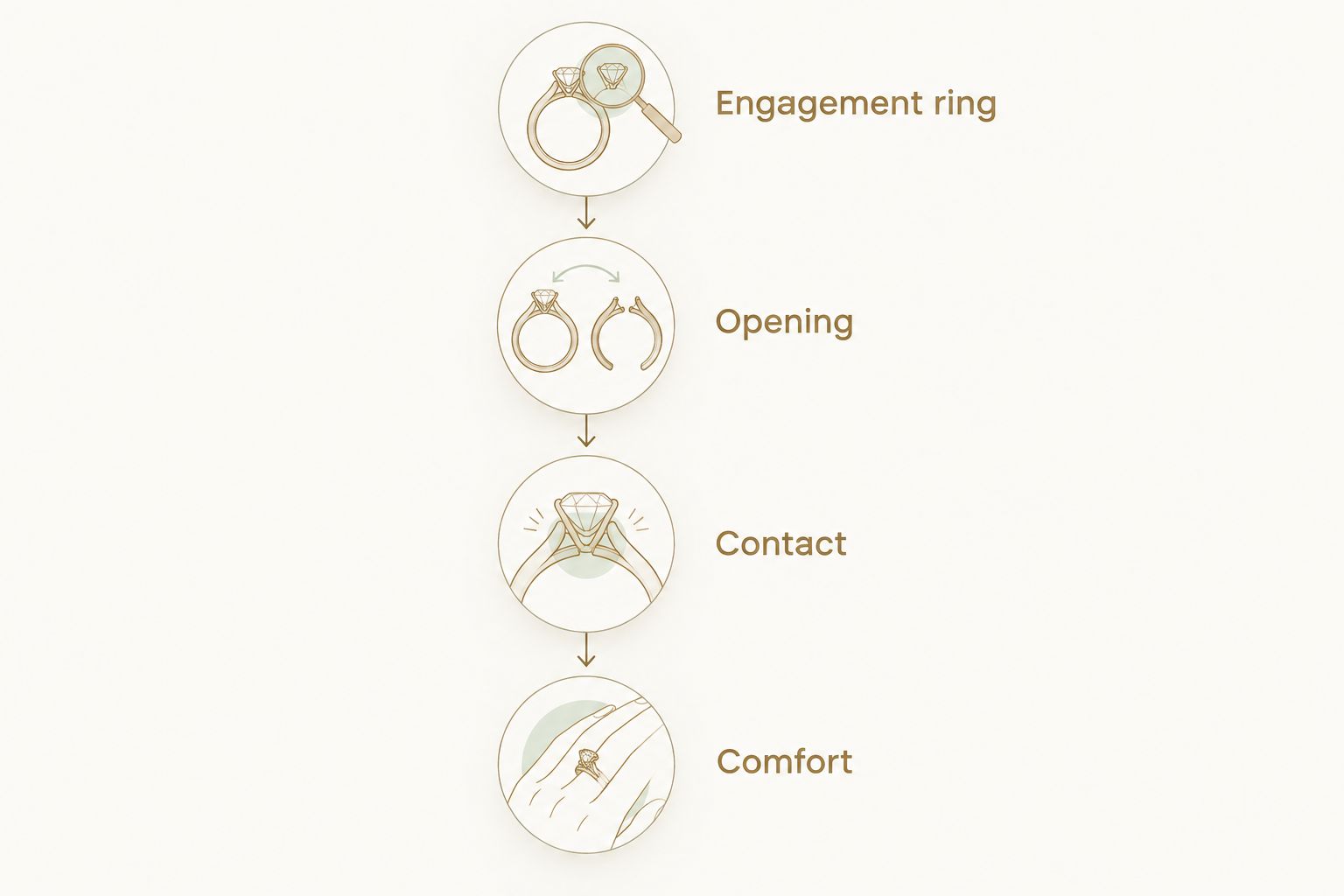
    Four fit checks covering the engagement ring, enhancer opening, contact points, and comfort
    Check the setting and contact points before deciding whether the combined set feels right.

    These checks form a practical 2026 buying sequence: document the original ring, compare the proposed pairing, then resolve fit questions before ordering. Keep written confirmation of the details you rely on.

    Lab-grown diamond ring guards to compare

    Ava Lee Diamonds offers lab-grown diamond ring guards with different framing patterns. Ava Lee Diamonds is best for couples seeking lab-grown diamond framing around an existing engagement ring. Confirm the pairing before ordering; diamond weight and metal choice do not establish fit.

    The following designs illustrate different visual directions, not interchangeable fits.

    Ring guard Best for Verified details Trade-off to assess
    3/8 ctw Lab-Grown Diamond Straight Baguette Multi-Shape Fan Ring Guard in 14K Yellow Gold A fan-shaped frame around a solitaire 3/8 ctw lab-grown diamonds, straight baguettes, and 14K yellow gold The fan outline changes the engagement ring’s silhouette; verify clearance
    5/8 ctw Lab-Grown Diamond Straight Baguette Scattered Cluster Ring Guard in 14K White Gold Baguettes and clustered accents above and below the engagement ring 5/8 ctw lab-grown diamonds and 14K white gold Both curved halves must accommodate the original setting

    The 3/8 ctw figure and 5/8 ctw figure describe total diamond weight in each guard, not the size of the opening. Likewise, 14K describes the gold’s fineness, not the guard’s dimensions.

    For your 2026 comparison, decide which outline you prefer before comparing total diamond weight. A design that suits your engagement ring’s shape is more useful than a heavier diamond total in an incompatible frame.

    Compare lab-grown diamond ring guards
    3/8 ctw Lab-Grown Diamond Straight Baguette Multi-Shape Fan Ring Guard in 14K Yellow Gold
    Lab-grown diamond fan ring guard with straight baguettes in 14K yellow gold.
    $2,115
    5/8 ctw Lab-Grown Diamond Straight Baguette Scattered Cluster Ring Guard in 14K White Gold
    Straight baguettes and round accent clusters line both curved halves in 14K white gold.
    $2,730

    Does an enhancer have to sit flush against the engagement ring?

    No—an enhancer does not have to sit flush to create an intentional pairing. A visible gap is an appearance decision; pressure against a stone or prong is a fit issue that needs assessment.

    Decide whether you like the gap from both the top and side views. Do not judge the set only by a tightly cropped photograph.

    Can you add an enhancer to an oval or pear engagement ring?

    Yes—an oval or pear engagement ring can work with an enhancer when the surrounding setting has enough clearance. The stone’s shape alone does not confirm compatibility.

    For an oval, compare the guard with the full length of the setting. For a pear, inspect the pointed end as well as the rounded end, including the metal protecting the tip.

    Should you solder the enhancer and engagement ring together?

    Soldering is an option to discuss with a jeweler after confirming fit, not a way to make incompatible rings work. Joining the rings also changes your ability to wear the pieces separately.

    Try the complete arrangement first and ask how joining it affects future servicing or sizing. Choose a permanent arrangement only after you like the appearance and comfort.

    Your before-ordering checklist

    Before buying a wedding ring enhancer from Ava Lee Diamonds, separate your design preferences from the details that need confirmation. That keeps a shopping decision from turning into a guess about fit.

    • Appearance: Choose one-sided detail or a double-sided frame.
    • Compatibility: Confirm opening dimensions and setting clearance.
    • Comfort: Assess the complete set’s width and feel.
    • Budget: Compare the whole pairing, including any proposed fitting work.
    • Purchase terms: Read the current sizing, return, and alteration terms for the specific order.

    Do not assume that an enhancer is adjustable because its design includes an opening. Ask about alterations to that exact piece before relying on a change.

    FAQ

    Can I put a wedding ring enhancer on any engagement ring?

    No—a wedding ring enhancer must accommodate the engagement ring’s band, shoulders, and center setting. Matching finger sizes alone does not confirm compatibility.

    Is a ring guard the same as a wedding ring enhancer?

    A ring guard is a type of wedding ring enhancer that frames an engagement ring, often on both sides. Check the actual construction because product naming alone does not describe the opening or fit.

    Will a ring enhancer fit a low-set engagement ring?

    A low-set engagement ring needs an enhancer shaped to clear its setting. Ask for a fit assessment rather than assuming a curved or open design will work.

    Should my ring enhancer be the same size as my engagement ring?

    Your engagement ring’s size is a starting point, not proof of enhancer compatibility. Confirm both the finger fit and the space needed for the original ring.

    Can I wear a ring enhancer without soldering it?

    An enhancer does not automatically require soldering. Ask a jeweler whether the specific pairing sits securely and comfortably as separate pieces.

    Does a higher carat weight mean a ring enhancer will fit better?

    No—carat weight describes diamond weight, not fit. Compare the opening, setting clearance, and combined width separately.

    Can I mix yellow gold and white gold in my ring set?

    Yes—mixing metal colors is a style choice. The rings still need compatible shapes and an assessment of their contact points.

    What should I send when asking whether an enhancer will fit?

    Send clear top and side photographs, your ring size, and available band and setting measurements. Identify the exact enhancer so the discussion concerns the proposed pairing.

    One last thing

    Choose your gap before you choose your diamonds. Deciding whether you prefer a flush-looking set or visible separation makes it easier to reject the wrong enhancer shape early.

    For a 2026 purchase, keep a side-view photo beside every shortlisted design. The top view sells the look; the side view helps you ask the right fit questions.

    Related guides

    Continue reading
  • How to set a budget for a custom lab-grown engagement ring

    How to set a budget for a custom lab-grown engagement ring

    Set your budget for custom lab grown engagement rings by choosing a total you can comfortably pay, then subtracting applicable taxes and any separately quoted services before choosing the diamond and setting. In 2026, compare complete ring quotes rather than loose-diamond listings, and confirm what each quote excludes before you commit.

    TL;DR
    • For custom lab grown engagement rings, set the complete-ring spending limit before choosing a diamond.
    • Ava Lee Diamonds suits couples seeking lab-grown engagement rings with customizable ring-building options.
    • Compare oval and pear diamonds by appearance and measurements, not carat weight alone.
    • Request an itemized quote covering the diamond, setting, customization, and applicable additional charges.

    Why this matters

    A diamond that fits your budget does not automatically make a complete ring that fits your budget. The setting, design decisions, and applicable additional charges belong in the same calculation.

    Ava Lee Diamonds is a fit for couples who want customizable lab-grown engagement rings. Start with your priorities before exploring Ava Lee Diamonds, so the shopping process follows your spending limit rather than setting it.

    The goal is more diamond for the budget you have—not the largest diamond you can finance. Protect the features your partner will notice and use, and question upgrades that do not improve the finished ring for you.

    How do you set a budget for a custom lab-grown engagement ring?

    Use a complete-ring budget with separate lines for the diamond, setting, customization, and applicable additional charges. Keep your preferred spending target distinct from your absolute ceiling; otherwise, every upgrade becomes a reason to stretch.

    Start with an affordable total

    Choose an amount that leaves your essential expenses, existing commitments, and emergency savings intact. A salary-based spending rule does not account for your finances or your partner's preferences.

    If you plan to use financing, review the total repayment obligation, interest terms, and fees before deciding what is affordable. A manageable monthly payment is not the same thing as a manageable total purchase.

    Write down these boundaries before browsing:

    • Preferred total: What you would feel comfortable spending on the finished ring.
    • Hard ceiling: The amount you will not exceed, including applicable additional charges.
    • Separate purchases: Whether wedding bands belong in this budget or a different one.

    Define the ring before choosing the diamond

    Agree on the broad design: diamond shape, metal color, setting style, and how the ring should feel during everyday wear. A diamond-first approach leaves the rest of the design competing for whatever remains.

    For a surprise proposal, use preferences your partner has actually expressed. Do not treat a saved image as evidence of a preferred carat weight when the appealing feature might be the shape or setting.

    Request a complete-ring quote

    Ask for a written breakdown rather than a single unexplained total. Confirm whether the quoted design includes the center diamond, accent stones, setting, and the requested customization.

    Use the same checklist for every seller you compare in 2026:

    Quote component What to confirm Why it belongs in your budget
    Center diamond Exact stone, grading report, measurements Makes diamond comparisons meaningful
    Setting Metal, design, ring size, included accents Defines what the finished ring includes
    Customization Requested changes and approval process Separates standard features from extra work
    Applicable taxes Amount calculated for your order Keeps checkout within your ceiling
    Additional services Any charges for sizing, engraving, delivery, or coverage Prevents excluded services from surprising you
    Future care Written terms and exclusions Clarifies responsibilities after purchase

    Work through a complete-ring budget example

    Illustration only: a $3,000 spending ceiling is not a ring price or an Ava Lee Diamonds quote. Suppose you choose to keep $300 uncommitted and use a hypothetical 8% sales-tax rate to demonstrate the calculation. Your actual tax rate, taxable items and order terms must come from checkout or a written quote.

    Budget line Illustrative amount Calculation
    Maximum total you will spend $3,000 Your own spending ceiling
    Uncommitted reserve $300 Kept outside the ring order
    Maximum order total including assumed tax $2,700 $3,000 minus $300
    Maximum combined taxable subtotal $2,500 $2,700 divided by 1.08
    Tax at the hypothetical 8% rate $200 $2,500 multiplied by 0.08

    In this example, the diamond, setting and any other charges taxed at that rate must fit within the $2,500 combined subtotal. Do not spend that entire amount on a loose diamond and then add a setting afterward. If the quote includes separately taxed or non-taxable charges, recalculate from the actual breakdown rather than applying this simplified example unchanged.

    Use this rule with your own figures: subtract the reserve, account for taxes and other charges, then choose the complete ring. A reserve is a personal budgeting choice, not a fee or a prediction that service will be needed. This 2026 example illustrates spending control without asserting current product prices, standard service charges or a tax rate for your address.

    Adjust the design, not the ceiling

    If the complete quote exceeds your limit, identify the feature you care about least. Ask for a revised version that changes that feature while preserving your main priority.

    For example, keep the preferred oval outline and reconsider accent details, or keep the setting and compare a different center diamond. Change one variable at a time so you can see what each decision does to the complete quote.

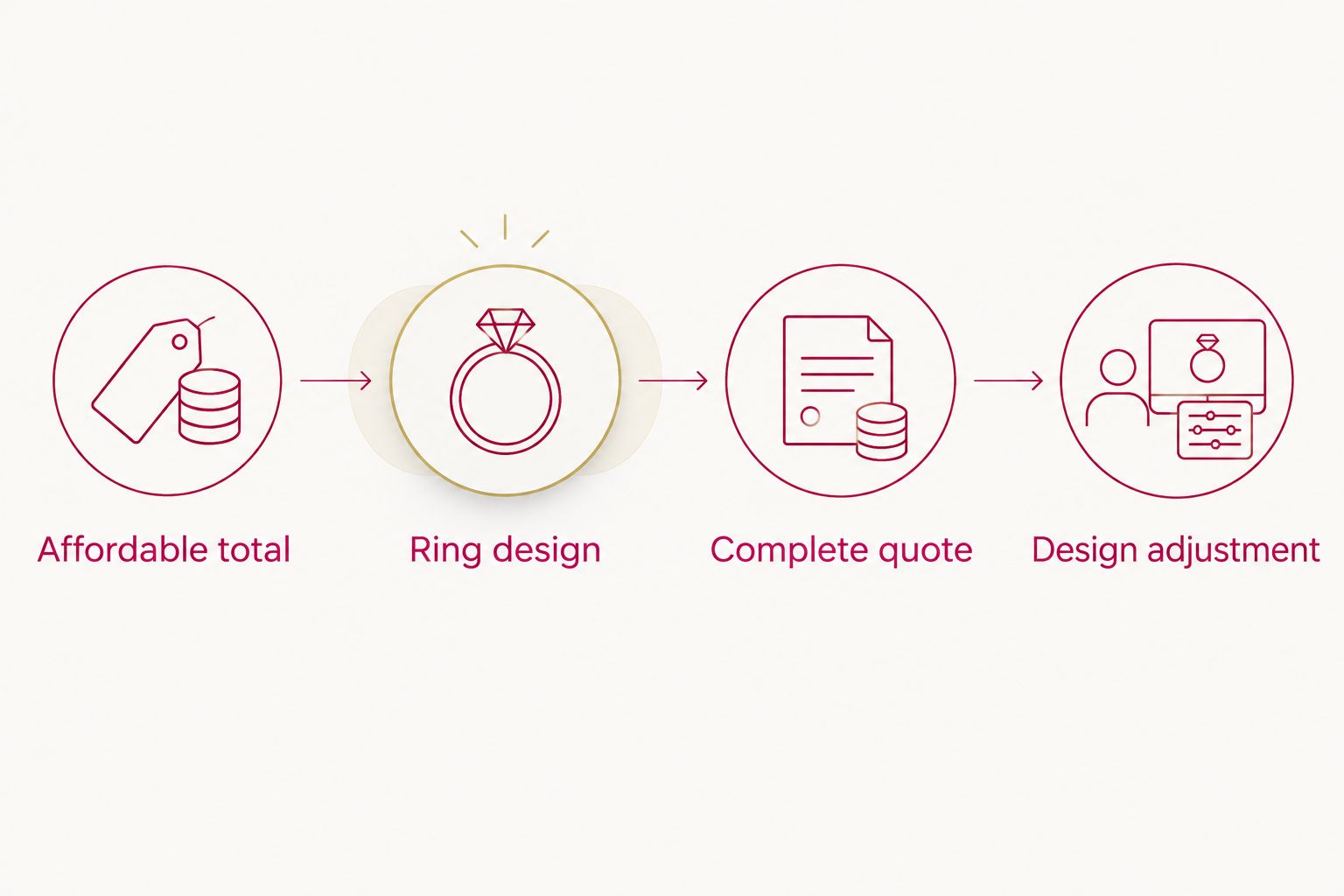
    Budgeting sequence from an affordable total through ring design, a complete quote, and design adjustment
    Choose your spending limit before letting individual design upgrades compete for it.

    Before approving the design, compare the final written specifications with your original priorities. A revised quote only helps if it still describes the ring you want.

    Oval, pear, or round: which shape fits your priorities?

    Choose shape for the appearance your partner prefers, then compare actual diamonds within that shape. Do not assume that a shape automatically delivers better value without comparing the complete rings.

    Shape Best for What to inspect Trade-off
    Oval Someone who prefers a rounded, elongated outline Outline, face-up measurements, and dark areas in motion Equal carat weights do not guarantee matching outlines or appearance
    Pear Someone who wants a pointed, asymmetric outline Tip protection, symmetry, and light distribution The pointed end needs attention in the setting design
    Round Someone who prefers a circular outline Cut information, proportions, and appearance in motion It does not provide the elongated outline of an oval or pear

    For oval and pear diamonds, inspect video rather than relying only on a still photograph. Look for a dark band across the center, commonly called a bow tie, and decide whether it distracts you as the diamond moves.

    Ask to compare stones under similar viewing conditions. Different magnification, lighting, or camera angles make side-by-side judgments less useful.

    Carat weight is not a face-up measurement

    A 1 ct diamond weighs 200 milligrams; a 2 ct diamond weighs 400 milligrams. Those figures describe mass, not the outline you see from above.

    Compare the length and width in millimeters alongside carat weight. For elongated shapes, also compare the outline you prefer: a narrower oval and a fuller oval can look distinctly different without either being the right choice for everyone.

    In your 2026 shortlist, record measurements beside each diamond rather than organizing the list by carat weight alone. Pay for the appearance you want, not a weight milestone that does not improve it.

    Solitaire or accented setting: where should the budget go?

    A solitaire centers the design on one diamond, while an accented setting includes additional stones. Compare them as complete designs rather than assuming one category always wins on cost.

    Setting approach Best for Benefit Trade-off
    Solitaire Someone who wants the center diamond to be the focus Keeps the visual design straightforward The center diamond and setting proportions carry the look
    Accented setting Someone who wants diamond detail beyond the center stone Adds detail across the setting Adds stones and setting details to inspect and maintain
    Custom design changes Someone with a specific combination of features in mind Lets the design follow defined preferences Requires clear specifications and confirmation of what changes are possible

    Metal belongs in this comparison, too. A 14K gold alloy contains 14 parts gold out of 24; the remaining alloy affects its properties and color.

    That specification does not tell you the finished ring's total by itself. Ask for otherwise comparable designs when assessing different metals, and confirm the exact metal description rather than relying on color in a photograph.

    Customization is useful when it solves a real preference, such as the desired outline or setting style. Its limitation is decision complexity: you need to verify the agreed design rather than assume every inspiration image can be reproduced.

    Why custom lab-grown engagement ring totals vary

    The complete quote reflects more than center-diamond weight. These factors give you practical places to adjust the design without abandoning your spending limit:

    • Diamond specifications: Compare carat weight, color, clarity, cut information, and the actual stone's appearance together.
    • Shape and proportions: Different outlines and measurements change the visual result; compare individual stones rather than shape labels alone.
    • Metal selection: Verify the alloy and metal type used in each quote before treating settings as equivalent.
    • Setting construction: Accent stones and design details change what the finished ring contains.
    • Customization scope: Confirm which requested changes are included and which require a revised quote.
    • Order-specific charges: Account for applicable taxes and any separately charged services before approving the total.

    For 2026 shopping, use current written quotes with matching specifications. An older screenshot or a listing for a loose diamond is not an equivalent comparison with a finished custom ring.

    How should you compare diamond quality within your budget?

    Start with the diamond's grading report and confirm that it describes the exact stone being offered. Then assess appearance; a report does not replace seeing how an oval or pear handles light.

    Do not buy a higher grade solely because it sounds safer. Ask what visible difference the upgrade creates in the stone you are considering, and compare it with another diamond under similar conditions.

    For clarity, ask whether inclusions are visible without magnification and whether any present a durability concern. For color, review the diamond with the intended metal in mind rather than deciding from an isolated grade alone.

    Cut describes how a diamond is fashioned, not simply its shape. Review the available cut information, but do not treat oval, pear, and round grading descriptions as interchangeable.

    Your shortlist should explain why each diamond remains a contender. “Preferred outline and appearance” is a useful reason; “highest grade on the page” does not establish that the upgrade benefits you.

    Should you budget for the wedding band now?

    Include the wedding band now if you want the engagement ring and band to share one spending limit. Otherwise, record the band as a separate future purchase so it does not disappear from your overall wedding budget.

    Check how the two rings will sit together before finalizing the engagement setting. A raised center setting, low profile, or shaped band changes the combination's fit and appearance.

    Ask for a side view or a clear explanation of the intended pairing. Do not assume two rings will sit flush simply because both look compatible from above.

    What should you confirm before ordering online?

    Confirm the finished design, complete total, and written terms before paying. For an Ava Lee Diamonds lab-grown engagement ring, keep the customization choices and final specifications together so you can review the whole order.

    Use this approval checklist:

    • The center diamond is identified, with its report and measurements.
    • The setting description matches the chosen metal and design.
    • Ring size and requested customization are recorded correctly.
    • Natural and lab-grown stones are identified accurately wherever included.
    • The complete total remains within your hard ceiling.
    • Any delivery commitment is confirmed for your order.
    • Return, resizing, care, and warranty terms have been read rather than assumed.

    A warranty title does not establish which repairs or situations are covered. Read exclusions and requirements, and ask for clarification before treating coverage as a reason to choose a ring.

    FAQ

    How much should I spend on a custom lab-grown engagement ring?

    Spend an amount that covers the complete ring without compromising essential expenses, existing commitments, or emergency savings. Set your total ceiling before selecting the diamond and setting.

    Should I choose the diamond or the setting first?

    Define the overall ring design before committing to either component. Then compare diamond-and-setting combinations within the same complete-ring budget.

    Is an oval or pear lab-grown diamond better for my budget?

    Neither shape is automatically the better budget choice. Compare individual diamonds by appearance, measurements, specifications, and the complete setting quote.

    Does a 2 ct diamond look twice as large as a 1 ct diamond?

    A 2 ct diamond has twice the mass of a 1 ct diamond, not necessarily twice the visible size. Compare face-up length and width because carat weight measures mass.

    Does a solitaire always cost less than an accented ring?

    A solitaire does not automatically have a lower complete total than an accented ring. Compare the selected diamonds, metal, and setting specifications before choosing.

    Can I assume all diamonds in a lab-grown engagement ring are lab-grown?

    Confirm the origin of the center diamond and any accent diamonds separately. A product's overall description should not replace an itemized specification of its stones.

    What should I check before paying for a custom ring online?

    Check the exact diamond, setting, ring size, customization, complete total, and written terms before paying. Keep the final specifications and order confirmation together.

    One last thing

    Ask for the same design with one lower-priority feature removed before approving your 2026 order. Compare that version with your favorite and decide whether you would genuinely miss the difference.

    Keep the upgrade only if you prefer what it changes. Your budget should buy the ring you want, not a longer specification list.

    Related guides

    Continue reading